

 By ATN Editorial Team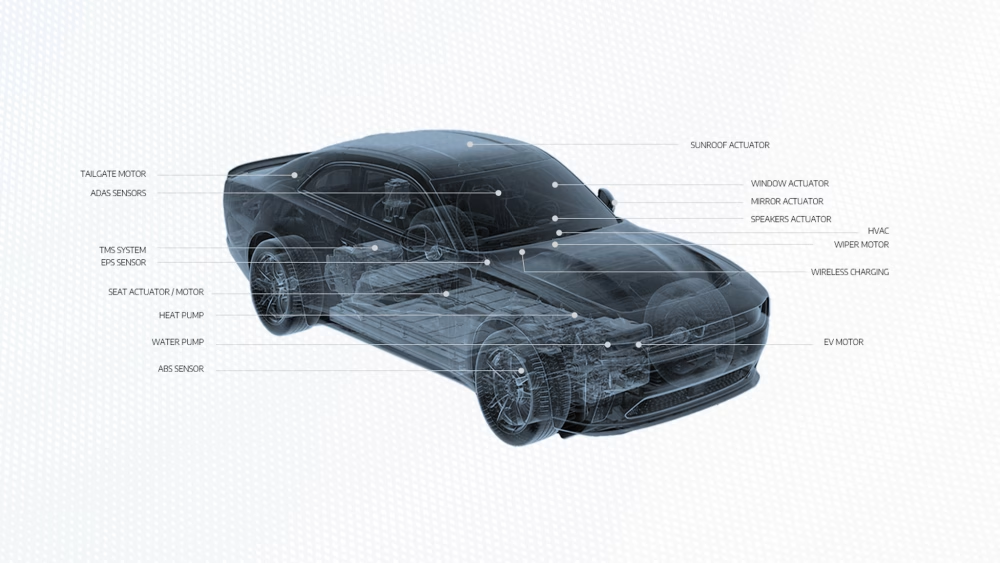
Summary: Niron Magnetics has partnered with Stellantis to develop rare-earth-free electric motors using Niron’s iron-nitride magnet technology. The collaboration targets “Variable Flux Field Intensifying Motors” designed for automotive traction and other systems, replacing traditional rare-earth magnets sourced from constrained supply chains. Supported by a U.S. Department of Energy grant and backed by Stellantis Ventures, the project also aligns with Niron’s commercial-scale magnet manufacturing plant in Minnesota.
Key engineering takeaway: Iron-nitride permanent magnets made from abundant iron and nitrogen enable high magnetisation without rare earths, supporting motor architecture innovations for traction and auxiliary systems.
Why it matters: By reducing reliance on rare-earth materials and shifting to domestically scalable production, this collaboration supports supply-chain resilience, cost reduction, and future-proofing of electric vehicle motor systems.
Niron Magnetics today announced a project in collaboration with Stellantis to develop a new generation of electric motor designs for automotive use using magnets free of rare-earth elements. Niron’s breakthrough Iron Nitride magnet technology offers a promising alternative to traditional rare-earth-based magnets, helping to reduce dependence on foreign-dominated supply chains.
The collaboration builds upon Stellantis Ventures’ strategic investment in Niron Magnetics in 2023. It features additional support from the U.S. Department of Energy’s Advanced Materials and Manufacturing Technologies Office (AMMTO), which contributed $2.7 million to the project as part of its strategy to strengthen American energy independence and secure critical materials.
Permanent magnets play a vital role in dozens of vehicle systems, from audio and power steering to fluid pumps and powertrains. Magnets are critical components in a wide range of powertrains, including those used in internal combustion engines, hybrids, and electric vehicles.
Traditional permanent magnets rely heavily on rare earth elements, primarily sourced from China. In contrast, Niron Magnetics’ Iron Nitride magnets are made from abundant iron and atmospheric nitrogen, materials readily available in the United States and globally.
“Collaborating with the Niron Magnetics team allows us to explore the possibilities of this innovative magnet technology,” said Micky Bly, senior vice president, head of propulsion systems engineering for Stellantis. “As part of our broader research into advanced propulsion solutions, we’re continually evaluating emerging technologies that could support future mobility options and enhance customer choice.”
The Stellantis-Niron project aims to enhance motor architecture across all vehicle types by leveraging the unique properties of Iron Nitride magnets to deliver improved performance and efficiency.
“This collaboration is another critical notch of success in our strategy to scale our technology to meet the demands for permanent magnets and securing our domestic supply chains for leading manufacturers like our partners at Stellantis,” said Jonathan Rowntree, CEO of Niron Magnetics. “By switching to rare-earth-free Iron Nitride, we’re not only working together to build a more resilient foundation for industry but expanding the boundaries of what’s possible for motor performance.”
Titled “Variable Flux Field Intensifying Motors Using Iron Nitride Permanent Magnets,” the joint project builds on Stellantis’ investment and ongoing collaboration with Niron Magnetics in areas such as traction motors, automotive audio, and other magnet-driven systems.
The announcement coincides with the groundbreaking of Niron Magnetics’ first commercial-scale manufacturing facility in Sartell, Minnesota. When fully operational, the site will be one of North America’s largest magnet production facilities, producing 1,500 tons of magnets annually and creating 175 full-time jobs.
Niron Magnetics and Stellantis will also collaborate with leading research institutions, including Oak Ridge National Laboratory and the Illinois Institute of Technology, to leverage their expertise in advanced motor systems analysis and testing.
For more eMotor technology news, click here.
