

 By ATN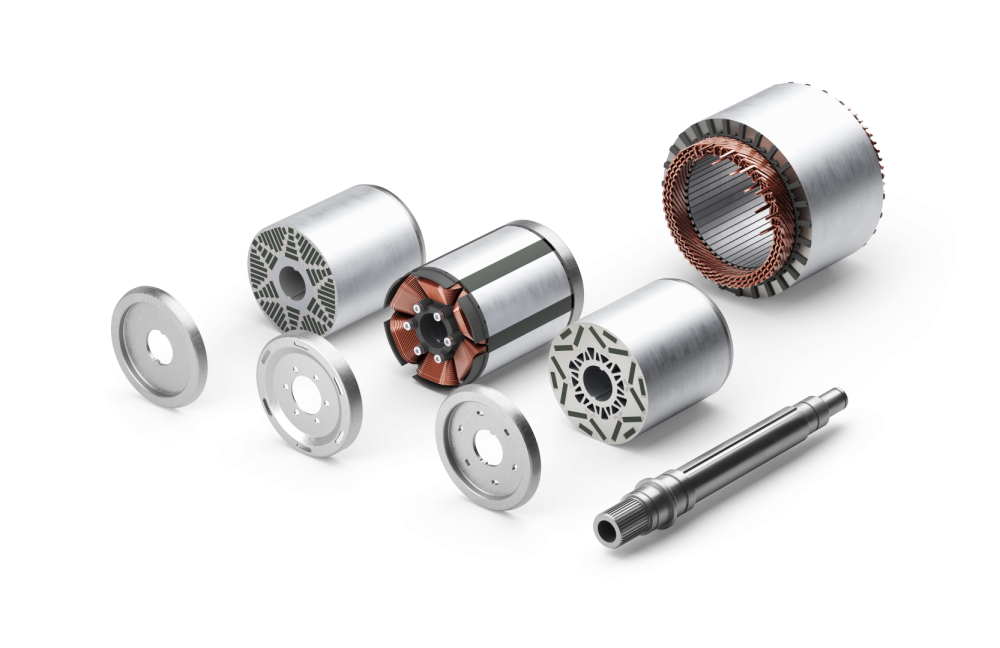
Summary: FEV and RWTH Aachen University’s Mechatronics in Mobile Propulsion group have co-developed a modular electric drive unit concept designed to eliminate the use of rare-earth materials. The system uses a shared stator, housing, cooling system, and converter, while interchangeable rotors allow different motor types—such as electrically excited, ferrite-based, or asynchronous machines—to be deployed. Delivering efficiencies up to 94%, the design enables OEMs to adapt to changing market and material conditions without sacrificing performance. A novel oil-cooling system directly targeting the stator and rotor boosts continuous power output by up to 75% compared to conventional systems.
Key engineering takeaway: The modular drive unit architecture allows for multiple rare-earth-free motor topologies to use a common platform, improving design flexibility, reducing cost volatility, and increasing power density through advanced oil cooling.
Why it matters: By reducing dependence on rare-earth magnets and improving continuous power efficiency, this approach offers OEMs a scalable and sustainable route to meet performance targets while mitigating supply chain and environmental risks.
FEV has partnered with the Teaching and Research Area Mechatronics in Mobile Propulsion (MMP) at RWTH Aachen University to develop a modular concept for electric drive units. The approach significantly reduces dependence on critical raw materials such as rare-earth magnets in electric machines. The objective is to completely eliminate the use of rare-earth elements, which are costly and available only in limited supply. Their mining also presents significant environmental and geopolitical challenges. The developed concept uses a design with a common stator, housing, cooling system, and converter, while the rotors are interchangeable. Studies have shown that the rare-earth-free alternatives can achieve overall efficiencies of up to 94 percent while offering lower cost volatility and reduced CO₂ equivalents over the entire life cycle.
Permanently excited synchronous machines with rare-earth magnets are the most common type of drive found in today’s electric vehicles. The high magnetic flux density of the permanent magnets enables optimum efficiency and excellent performance in a compact design. However, for the reasons mentioned above, this technology is associated with growing risks. For their study, experts from FEV and RWTH Aachen University developed solutions using electrically excited synchronous machines, ferrite-based electric machines, as well as asynchronous machines, and examined them in terms of performance, cost, and environmental compatibility. The platform concept is engineered to meet varying power demands in the mid-range (C segment) and luxury (D segment) vehicle classes, delivering peak outputs of 160 kW and 250 kW respectively. It also supports scalable adaptation for lower vehicle segments through modular design.
A central element of the concept is an innovative oil cooling system with direct stator and rotor cooling, which enables a significant increase in continuous power. The resulting ratios of continuous to maximum power significantly exceed those of conventional systems by up to 75 percent.
Future-proof prospectives for OEMs
“Our platform approach allows vehicle manufacturers to react faster and more flexibly to market shifts, raw material shortages, and cost fluctuations. This is achieved without compromising efficiency or performance,” said Patrick Hupperich, President and CEO of FEV Group.
The modular electric drive unit enables different concepts to be realized using the same stator and converter by simply changing the rotor. This flexibility allows OEMs to diversify their supply chains and reduces development costs. Additionally, it lowers overall costs through economies of scale. In addition, the rare-earth-free alternatives offer the opportunity to combine technological diversification with sustainability goals.
For more eMotor technology news, click here.
