

 By ATN Editorial Team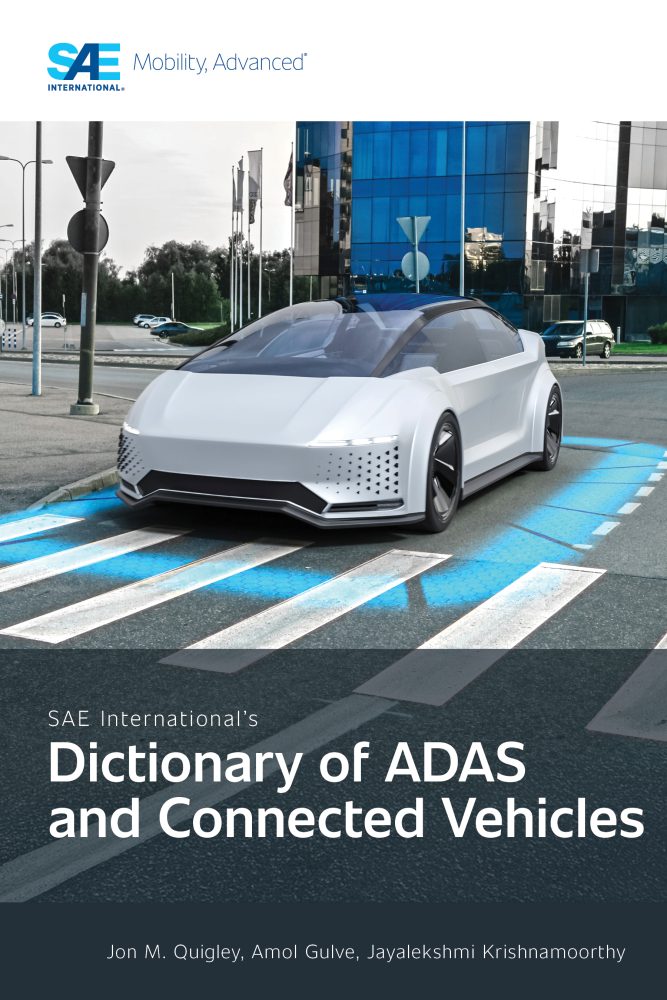
Jon M Quigley, author of SAE International’s Dictionary of ADAS and Connected Vehicles
One need not be in the industry for long to know that a common lexicon is important for actual communication. We have written about this for many years, including a story of starting a formal test and verification department at a vehicle original equipment manufacturer (OEM.). This is why we undertook the writing of four dictionaries through SAE International. The more complicated and complex the subject matter, the more important it is that the communication is clear.
The automotive industry is currently navigating a transformative era where Advanced Driver Assistance Systems (ADAS) and connected vehicle technologies are converging. While early ADAS functioned primarily as standalone systems—relying on vehicle-mounted sensors like radar, LiDAR, and cameras—the future of mobility hinges on the vehicle’s ability to communicate with everything around it. This shift from individual sensing to a networked ecosystem, known as Vehicle-to-Everything (V2X), aims to enhance vehicle safety, efficiency, and overall driving experience.
The Power of Standardization
At the heart of this connected revolution lies the need for a common technical foundation. For vehicles to communicate effectively across different manufacturers and infrastructures, they must speak the same language. In general, this is where the standards such as SAE J2735 V2X Communications Message Set Dictionary become indispensable.
By standardizing these messages, the industry ensures that a vehicle from one OEM can instantly “understand” the intent and status of a vehicle from another or even receive critical timing data from a smart intersection. This interoperability is the bedrock upon which safety-critical applications are built, moving the industry beyond proprietary silos toward a unified safety baseline.
Cooperative Driving Automation: Seeing the Unseen
While standard V2X provides awareness, Cooperative Driving Automation (CDA) moves into the realm of active cooperation between the driver, the vehicle, and the surrounding environment. CDA features allow vehicles to share not just their own status but also their “perception status,” effectively allowing a car to see through others’ eyes.
A primary use case for this is Occluded Pedestrian Collision Avoidance, governed by the SAE J3251 standard. In a typical urban scenario, a large truck or building might block a vehicle’s onboard sensors from detecting a pedestrian entering a crosswalk. Through CDA, a vehicle with a clear line of sight—or a smart roadside unit (RSU)—can broadcast the pedestrian’s position to oncoming traffic via a Personal Safety Message (PSM). This “perception sharing” allows the receiving vehicle to identify a hazard well before its own cameras or radar can detect it, triggering automated interventions like emergency braking much earlier than conventional systems.
Furthermore, CDA facilitates more efficient maneuvers through Collaborative Driving. By sharing intent—such as a planned lane change or an upcoming emergency braking event—vehicles can coordinate their actions. This reduces the “reaction gap” that typically leads to rear-end collisions and allows for tighter, more efficient vehicle spacing, known as platooning.
Infrastructure Guidance: Navigating the Complex Left Turn
One of the most dangerous maneuvers in any driving environment is the permissive left turn across opposing traffic. To address this, the industry is leveraging Cooperative Infrastructure (CDA-I) as defined in SAE J3282.
In a Connected Intersection, the infrastructure itself becomes an active participant in the driving task. RSUs mounted at the intersection broadcast Signal Phase and Timing (SPaT) and MapData (MAP) messages. In complex scenarios, the infrastructure can provide guidance to a vehicle’s ADAS, confirming the size of a gap in opposing traffic or warning of a high-speed vehicle approaching from a blind spot.
This infrastructure-led safety layer is a component of Cooperative Intersection Safety (CIS). By integrating real-time data from roadside sensors with vehicle telemetry, these systems can predict potential collisions at junctions and provide visual, auditory, or haptic alerts to the driver—or even take over braking and steering if the driver fails to respond.
Predictive Modeling: Anticipating the Road Ahead
The ultimate goal of a connected vehicle ecosystem is to transition from human reactive safety to Predictive Traffic Modeling. This involves an analytical framework that uses historical travel data, real-time sensor inputs, and machine learning (ML) algorithms to forecast traffic conditions before they occur.
Predictive Traffic Analytics enable vehicles and traffic management systems (TMS) to anticipate future congestion or bottlenecks. For instance, by analyzing vast sets of Big Data collected from fleet telemetry, ML models can identify recurring patterns that precede traffic jams or high-risk incidents. This enables Dynamic Route Optimization (DRO), in which the vehicle or a cloud-based TMS suggests alternative paths in real time to avoid anticipated slowdowns.
To manage the massive computational load required for these real-time predictions, the industry is turning to Multi-Access Edge Computing (MEC). MEC brings cloud-like computing capabilities to the “edge” of the network—such as cellular base stations or RSUs—enabling near-instantaneous data processing. By analyzing data locally rather than sending it to a centralized data center, MEC minimizes latency, which is critical for safety-sensitive applications like pedestrian detection and intersection collision warning.
The Path Forward: A Culture of Rigorous Validation
As we integrate these advanced V2X and AI-driven technologies, the complexity of testing and verification increases exponentially. Moving beyond simple compliance, organizations must adopt a multimodal approach to verification. This includes Scenario-Based Testing, where vehicles are evaluated under thousands of simulated real-world edge cases to ensure reliability.
Furthermore, the implementation of these systems requires a robust organizational learning culture. Because technologies and standards like J2735 and ISO 26262 are constantly evolving, engineering teams must prioritize the mechanization of knowledge—ensuring that lessons learned during the development of one vehicle generation are institutionalized and available for the next.
The convergence of ADAS, V2X, and predictive modeling is more than just a technological upgrade; it is a fundamental redesign of the transportation landscape. By adopting a common lexicon, embracing cooperative automation, and leveraging predictive analytics, the automotive industry is not just building smarter cars—it is creating a safer, more sustainable environment for everyone on the road.
For the latest V2X technology news, click here.
