

 By ATN Editorial Team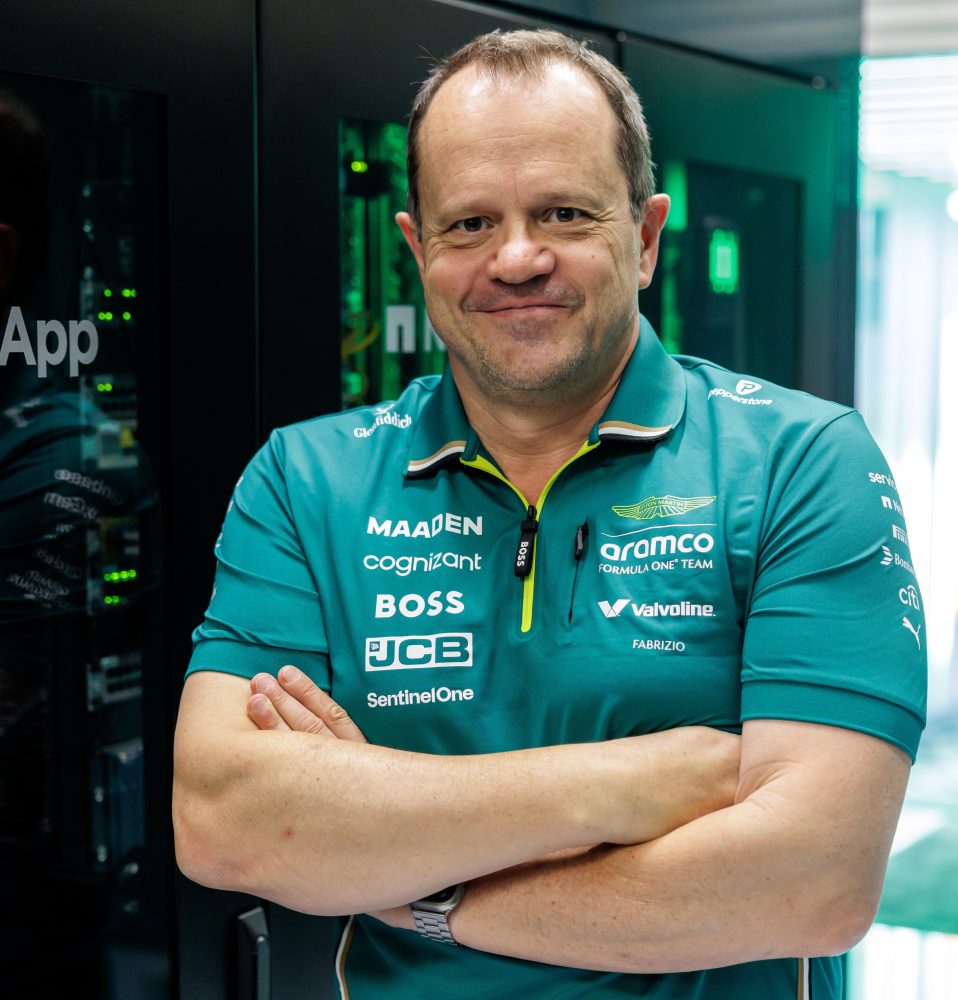
Author: Fabrizio Pilotti, Chief Information Officer at Aston Martin Aramco Formula One™ Team
Formula One is a sport of extremes, not just in a sporting sense, but in the intensity of engineering challenges it compresses into impossibly tight timelines. Take the car itself – over 13,000 components created to operate in perfect unison, with between 10-15 new components introduced every race. Zoom out to the course of an entire season, and 70-80% of the car will change. In practical terms, this adds up to a sport that is defined by marginal gains. Though, increasingly, these gains lie not only in the physical components but in the data, too, with AI redefining what engineering teams can achieve in the sport and beyond.
Modern race engineering requires the evaluation of highly interdependent variables, from aerodynamics and materials to environmental factors such as temperature, pressure and humidity. Traditionally, navigating this complexity has relied on deep expertise and time-intensive validation cycles. But in the context of Formula One, time is a constraint engineers cannot afford.
Where AI changes Formula One engineering
AI offers a way to rebalance the equation. Rather than processing data sequentially, engineers can begin to interrogate it in real time – quickly identifying patterns, trade-offs and insights that might otherwise take days to uncover. The impact is practical: less time spent searching for answers, and more time acting on them. Analysis is starting to shift from a bottleneck to an accelerant.
Designing in hours instead of days
This shift is particularly significant in the design phase. With components evolving at pace – and a new part designed, on average, every 15 minutes – the ability to explore more design options efficiently gives teams an edge. AI can start to highlight promising configurations earlier – whether through identifying new material combinations or aerodynamic concepts worth testing. It doesn’t replace established validation methods such as computational fluid dynamics (CFD), Driver in the Loop (DIL) or wind tunnel testing. Instead, it can be used to enhance them, ensuring engineering efforts are focused where it will have the biggest impact.
Closing the gap between design and track
A key opportunity lies in connecting design more closely to real-world conditions. Factors like wind directly affect car behaviour, yet historically have been difficult to integrate dynamically into the car’s set-up. This can create a delay between what happens on track and adjustments made in the name of performance.
AI could begin to close that gap. By analysing track conditions in near real-time, it could move to a place of spotting performance changes and suggesting targeted improvements – such as software updates or changes to the chassis. These insights will feed directly into existing workflows, accelerating iterations without skipping on validation. The result promises to be a more responsive design process, closer to real-time adaptation.
Beyond design, decision-making itself presents challenges of its own. Engineers must operate within strict cost caps and regulatory constraints, balancing technical performance with practical limitations. The challenge is not just solving problems but prioritising the right one.
AI as a decision-support layer
Here, AI acts as a decision-support layer. By synthesising complex datasets and outlining the implications of different choices, it enables faster, more informed decision making. Importantly, this is not about replacing human judgement but, once again, enhancing it – giving engineers more data so they can act with greater confidence.
We’re starting to see this in action through our partnership with NetApp which provides the scalable data storage that we need to support our AI-driven design, simulation and race-day strategy. This will enable engineers to process vast telemetry datasets and accelerate simulations, both trackside and at the factory. With 50 billion sensor data points per car per race, these capabilities are now mission critical.
These benefits extend across the wider organisation. From manufacturing and supply chain planning to race operations, AI can help to streamline engineering and operational workflows, automate routine analysis and improve knowledge sharing between teams. In an environment where delays often stem from fragmented information, better connectivity becomes a considerable advantage, unlocking efficiencies across the organisation. A good example being our partnership with CoreWeave, our AI Cloud Computing Partner. CoreWeave supports the team in relocating on-premise computing infrastructure to a cloud computing environment, for greater agility and efficiency.
As AI becomes embedded within engineering workflows, demand for high-performance, reliable compute environments increases significantly. Processing speed, system uptime and data accessibility are no longer background considerations – they are central to competitive performance.
Teams are responding by investing in enterprise-grade cloud platforms and specialised architectures designed for accelerated workloads. The ability to train models, run simulations and deploy insights quickly now plays a more direct role in supporting pit-side operations. In this sense, a parallel race is emerging – one that takes place within data centres, software platforms and the integration layers that connect them to engineering teams.
From Formula One to the wider automotive industry
The broader picture is that automotive engineering is becoming more interconnected, more data-driven and more time-sensitive than ever before. AI is not a standalone solution, nor a replacement for engineering expertise. It is an enabling capability – one that helps teams manage complexity, compress timelines and improve decision-making under pressure.
For engineers, the challenge is evolving. It is no longer just about designing better systems, but about designing better ways of working: integrating AI into workflows, building infrastructure to support it, and – ultimately – translating its outputs into performance gains.
In Formula One, the impact is immediate and measurable. But its significance extends far beyond the circuit. As the automotive industry continues to evolve – across electrification, sustainability and advanced mobility – the ability to harness AI effectively will define those who can move fastest, adapt quickest and innovate most successfully.
Formula One, sometimes described as ‘the fastest R&D lab on Earth’ is not just accelerating cars – but the future of engineering itself.
For more AI technology stories, click here.
Frequently Asked Questions
AI lets race engineering teams interrogate highly interdependent variables, aerodynamics, materials, tyre behaviour, temperature, pressure, humidity, in real time, identifying patterns, trade-offs and insights that traditional sequential analysis takes days to uncover. It compresses validation cycles in a sport where 70-80% of the car changes over a season and 10-15 new components are introduced every race.
No. AI in Formula One operates as a decision-support layer: it surfaces patterns, runs scenario evaluations and accelerates analysis, but final judgement on car set-up, strategy and component design still rests with race engineers. The expertise becomes more important, not less, because engineers now have to interrogate AI outputs as well as raw data.
AI in simulation collapses the gap between the design office and the track. Engineers can move from initial concept to driver-in-the-loop validation in hours rather than days, by using AI to predict aerodynamic and tyre behaviour, suggest design directions, and rapidly evaluate the trade-offs between competing component options before any physical hardware is built.
Formula One serves as a high-pressure proving ground for engineering AI. The same techniques, real-time multi-variable interrogation, AI-augmented design exploration, simulation-driven validation, translate directly to road-car engineering programmes, particularly in ADAS, vehicle dynamics, powertrain calibration and durability testing where similar trade-offs and time pressures apply.
For more AI news, click here.
