

 By ATN Editorial Team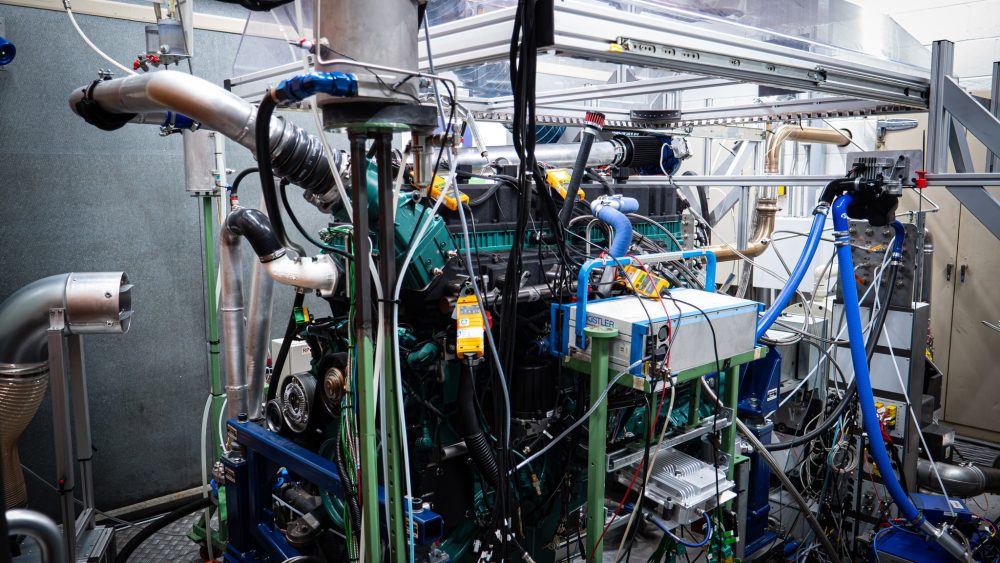
Summary: MAHLE Powertrain has hit a key milestone in Project Cavendish, converting a 13-litre heavy-duty engine to run purely on hydrogen and matching the maximum torque of the diesel baseline. Test data published on 20 April 2026 from the company’s Northampton facility show engine-out NOx is very low across the operating map, indicating that a hydrogen combustion engine plus a basic SCR aftertreatment can sit comfortably below EU VII tailpipe limits.
Key engineering takeaway: The 13-litre hydrogen combustion engine matched the diesel baseline’s peak torque, returned negligible particulate emissions (manageable with existing particulate filter technology) and is projected to land tailpipe NOx at well under 0.2 g/kWh after a Selective Catalytic Reduction (SCR) aftertreatment stage. Project Cavendish is a £9.8 million programme launched in early 2023 and supported by the Advanced Propulsion Centre UK (APC); MAHLE Powertrain has upgraded its Northampton testing infrastructure for hydrogen operation in parallel.
Why it matters: Heavy-duty hydrogen powertrains have largely been a fuel-cell story in the UK. Demonstrating a hydrogen combustion engine that meets diesel-equivalent torque with low engine-out NOx — and using off-the-shelf aftertreatment to clear EU VII — gives OEMs a faster-to-market route to zero-carbon trucks that re-uses much of the existing diesel powertrain architecture. The wider Cavendish consortium (PHINIA, BorgWarner, Cambustion, Hartridge and Oxford Brookes University) and the open-access Northampton test facility extend the data point well beyond a single MAHLE Powertrain programme.
- As part of Project Cavendish, MAHLE Powertrain (MPT) successfully converts a 13-litre heavy-duty engine to run purely on hydrogen
- Converted engine has matched the maximum torque of the diesel baseline engine
- MAHLE Powertrain’s test data show engine-out NOx was very low across entire engine operating map
- Jonathan Hall, Head of R&D at MPT: “Hydrogen combustion has a place as a clean fuel in the heavy-duty market.”
MAHLE Powertrain has achieved a major milestone in Project Cavendish, successfully converting a 13-litre heavy-duty engine to run purely on hydrogen. The converted engine has matched the maximum torque of the diesel baseline engine. Measured engine-out NOx suggest that emissions can be readily maintained below 0.2 g/kWh across the entire engine operating map using existing aftertreatment technology. Launched in early 2023, Project Cavendish is a £9.8 million programme supported by the Advanced Propulsion Centre UK (APC) that is developing end-to-end hydrogen powertrain capability for heavy-duty applications, supporting the UK’s transition towards net-zero transport. As part of Project Cavendish MAHLE Powertrain has upgraded its testing infrastructure in Northampton for Hydrogen operation.
This milestone demonstrates that hydrogen combustion has a place as a clean fuel in the heavy-duty market. Achieving the target torque and low raw engine out emissions from a hydrogen fuelled 13-litre heavy-duty engine represents a significant step forward, both for MAHLE Powertrain and for the wider industry, as we move towards practical hydrogen combustion solutions for heavy-duty applications.
Jonathan Hall, Head of Research and Advanced Engineering at MAHLE Powertrain
Achieving target torque was just the first step – the bigger challenge in hydrogen combustion is controlling NOx emissions. The measured raw engine out emissions are very low and the addition of a simple Selective Catalytic Reduction (SCR) aftertreatment system will enable the tailpipe emissions to be significantly less than EU VII limits. The measured particulate emissions were negligible and readily manageable using existing particulate filter technology. The results demonstrate that hydrogen combustion engines offer a practical, fast-to-market pathway towards zero-carbon heavy-duty transport.
What’s Next For Project Cavendish At Northampton
Project Cavendish also aims to facilitate wider hydrogen adoption by creating opportunities for external partners to undertake hydrogen engine testing at MAHLE Powertrain’s facility in Northampton, demonstrating the UK’s commitment to developing clean, practical solutions for the heavy-duty transport sector. The state-of-the-art facilities serve as a centre of excellence for the design, development, calibration, and testing of all aspects of hydrogen and renewable fuels powertrain engineering. MAHLE Powertrain has reported growing interest from new customers and expects commercialisation of its hydrogen and renewable fuels infrastructure to expand significantly over the coming year.
The project brings together expertise from MAHLE Powertrain, PHINIA, BorgWarner, Cambustion, Hartridge, and Oxford Brookes University to deliver the next generation of hydrogen combustion technology.
Within Project Cavendish and in other hydrogen-related activities, MAHLE Powertrain is leading the industry in hydrogen combustion and emissions development.
For more hydrogen combustion engine news, click here.
Related Hydrogen and Heavy-Duty Powertrain Coverage
- More hydrogen technology coverage on Auto Tech News
- EV vs Hybrid Powertrain: Which Fits Each OEM Strategy?
- HR18 Engine: Horse Powertrain’s 1.8-Litre Hybrid Explained
Hydrogen Combustion Engine: Frequently Asked Questions
Project Cavendish is a £9.8 million programme launched in early 2023 in which MAHLE Powertrain has converted a 13-litre heavy-duty engine to run purely on hydrogen. The programme is supported by the Advanced Propulsion Centre UK (APC) and is run from MAHLE’s Northampton facility, which has been upgraded for hydrogen operation.
MAHLE Powertrain’s 13-litre hydrogen combustion engine matched the maximum torque of the diesel baseline in tests published on 20 April 2026, with very low engine-out NOx across the operating map.
A hydrogen combustion engine burns hydrogen in a conventional reciprocating internal combustion engine, producing mechanical power directly and a small amount of NOx that requires aftertreatment. A hydrogen fuel cell converts hydrogen to electricity electrochemically and drives an electric motor. The combustion route re-uses much of the existing diesel powertrain architecture; the fuel-cell route requires a wholly new electric driveline.
The Cavendish project’s test data show engine-out NOx is very low across the operating map and projected tailpipe NOx of well under 0.2 g/kWh after a Selective Catalytic Reduction (SCR) aftertreatment stage. Particulate emissions are negligible and manageable with existing particulate filter technology. On those figures, the engine sits comfortably below EU VII tailpipe limits.
Heavy-duty hydrogen powertrains have largely been a fuel-cell story in the UK. A hydrogen combustion engine that matches diesel torque with low engine-out NOx — and uses off-the-shelf aftertreatment — gives OEMs a faster-to-market route to zero-carbon trucks that re-uses much of the existing diesel powertrain architecture, manufacturing base and service network.
