

 By ATN Editorial Team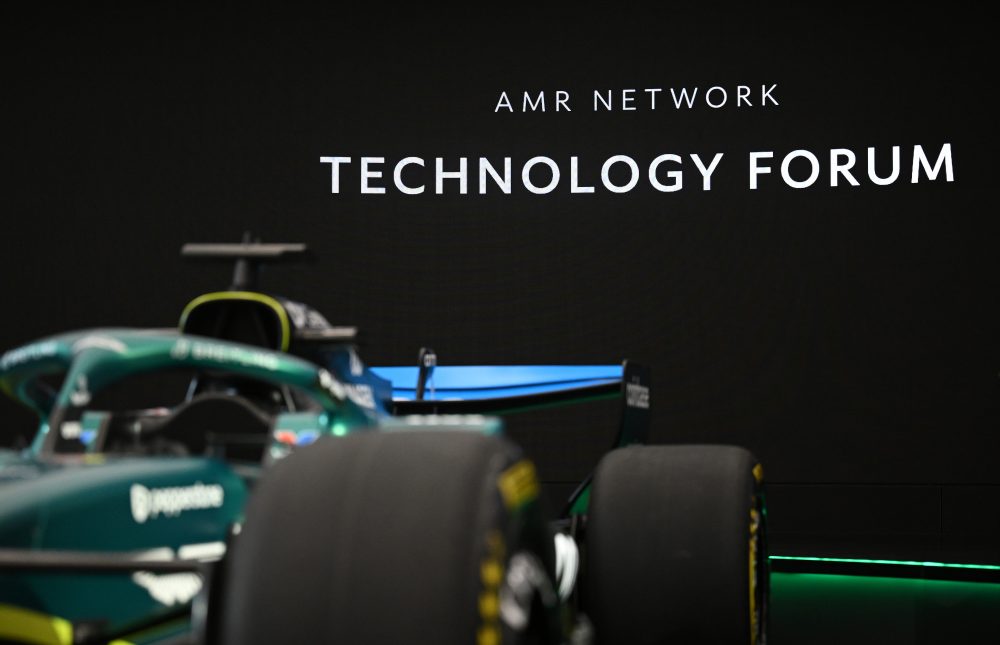
Auto Tech News was invited to the Aston Martin Aramco Formula One Team’s AMR Technology Campus at Silverstone on Friday 3 July for the launch of the AMR Network, held ahead of the British Grand Prix. The day brought together senior figures from the team’s ten technology partners for panels, roundtables and rare behind-the-scenes access. The unifying theme was AI in Formula 1: how the team applies it today, where it is heading, and what the sport’s approach can teach the wider engineering world.
The AMR Network is a new platform designed to bring the team’s partners together throughout the season for collaboration, discussion and thought leadership. The partner roster reads like a cross-section of the modern compute stack: Arm on silicon, CoreWeave on AI cloud computing, NetApp on data infrastructure, Cohere on large language models, Cognition on autonomous software engineering, Zscaler on zero-trust security, ServiceNow on enterprise workflow, Xerox on physical-to-digital workflows, Cognizant on systems integration and Eight Sleep on sleep and recovery.
The data problem this ecosystem serves is considerable. According to the team, 50 billion sensor data points are captured per car per race weekend, and each lap generates around 180 MB of car and garage data. Roughly 1.5 TB of data moves between the track and the team’s Silverstone Mission Control each week, arriving with a 0.2 second delay at most circuits. Once derived calculation channels are included, processing can reach 450 million data points per second, feeding 50 to 100 real-time decisions per lap.

How AI In Formula 1 Actually Works
Team Principal Adrian Newey drew a sharp line between the team’s use of machine learning and the popular image of AI. “Most people think of AI as pattern recognition combined with an internet search. What we’re doing is using AI and machine learning in very specialised roles that don’t rely on the internet at all. We’re feeding in our own data (wind tunnel, CFD, track) and using AI to spot patterns, correlations and trends that a human might not see quickly enough. It helps us make better decisions about how to develop the car.”
The harder problem, he suggested, is judgement. “The really interesting challenge is trying to give it something approaching ‘intuition’. Humans are very good at that, seeing patterns, making leaps, but that’s the hardest thing to define and encode. That’s the frontier we’re working on.”
Removing A Sensor With Software
The clearest example of applied AI in Formula 1 came from discussion of the car itself. The team currently runs an optical speed-over-ground sensor, which measures the car’s true velocity over the track surface. From that, engineers derive slip angle, a critical input for understanding tyre behaviour and predicting tyre life. The sensor weighs 0.5 kg.
The plan is to remove it. A machine-learned algorithm will infer the same slip angle information from the car’s existing sensor set, making the physical unit redundant and saving critical weight. Virtual sensing is a well-established ambition in production vehicle engineering, where software-derived channels replace costly hardware. Seeing it deployed to save mass at the sharp end of motorsport is a useful signal that the technique is ready for the mainstream.
Behind The Scenes At Silverstone
A tour of the AMR Technology Campus was a reminder that, for all the talk of algorithms, this remains an operation built around people. In the composite rooms, technicians were laying up new components. In the Quality room, parts were being checked against tolerances. In the build bays, the cars themselves were coming together, and in the vast design office, engineers were shaping what comes next, Adrian Newey among them at his drawing board, working on the next iteration of designs. On the evidence of the forum, the team’s ambition for AI is to give those people faster answers, not to replace them.
The day ended in Mission Control during sprint qualifying. Rows of engineers watching live telemetry and making quick, real time decisions based on the activity on track. According to the team, 10,000 to 100,000 race scenarios are run virtually ahead of a race weekend, with 200 to 300 variables feeding a single strategic decision. Watching that machinery operate quietly under session pressure was the most persuasive argument of the day for AI as a decision-support tool rather than a replacement for engineering judgement.

Why It Matters Beyond The Paddock
The panel discussions kept returning to the same point: Formula 1 is a compressed test case for industrial AI. Cohere’s Ryan Lewis noted that “whether it’s telemetry, diagnostics or simulation data, AI can dramatically reduce the time needed to understand what’s happening and support high-stakes decision making.” Zscaler’s Sunil Frida flagged the security consequence: as AI agents proliferate, “every agent becomes another identity that must be secured.” NetApp’s Gabie Boko argued that “what matters is not just where data lives, but how quickly it moves and how effectively it can be used.”
For automotive engineers, the transfer is direct. Virtual sensing, simulation-led development and secure, low-latency data infrastructure are the same problems facing every OEM and tier one supplier, just with different deadlines. The AMR Network will run as a season-long programme of events and content, and on this evidence, AI in Formula 1 is a conversation worth following.
For more AI news, click here.
