

 By ATN Editorial Team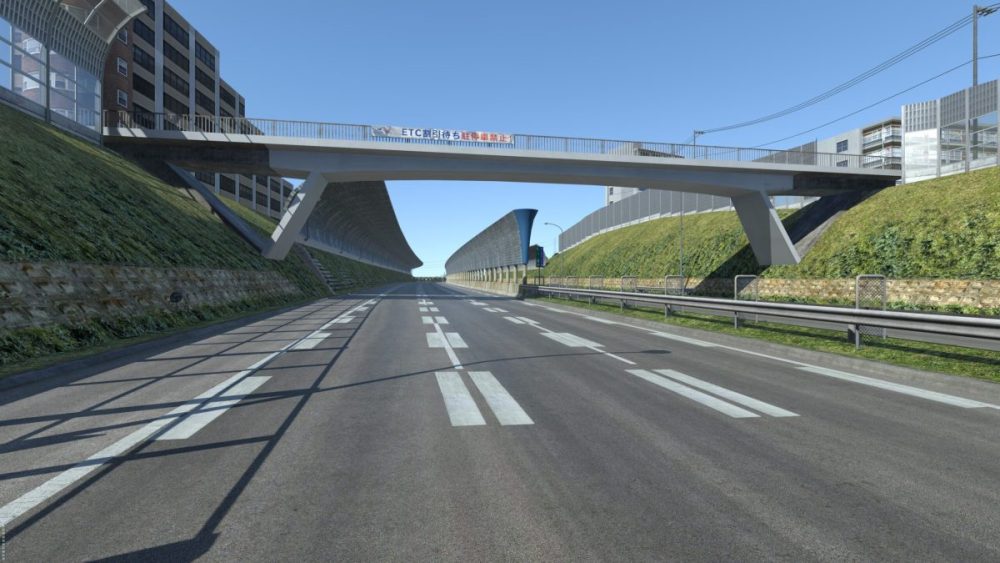
rFpro has been commissioned by a major OEM to create a digital twin of the Tōmei Expressway in Japan. The virtual model will largely be used for powertrain calibration, including optimising driveability, efficiency and WLTP assessment, as well as high-speed development.
“Powertrain calibration is often a compromise between optimising efficiency and driving dynamics,” said Matt Daley, Technical Director at rFpro. “This combination of objective and subjective targets makes driver inputs and assessment critical to the development programme. Using simulation and our Tōmei digital twin, a powertrain can be thoroughly assessed and developed in a representative highway environment early in the development cycle.”
Thorough WLTP assessment evaluates a range of driving styles, types of routes and varying weather and traffic conditions. Conducting this type of testing in the real-world is time and cost-intensive and requires a prototype vehicle. Simulation provides a more efficient means of testing and enables development to begin while the vehicle or powertrain is still model-based.In addition to powertrain development, the long straights of the digital twin are particularly suited to high-speed testing. This includes assessing the safety and stability of the vehicle, NVH and testing ADAS and AD systems in a high-speed environment.

The digital twin has been developed using survey-grade LiDAR scan data to create a vehicle dynamics grade road surface, which is accurate to within 1mm in height. This is key to accurately simulating the effects of every bump, drain cover and painted line.The model features 45km of driveable road and three toll sections, including a complex 24-lane toll plaza. High, over-hanging walls at the roadside create an interesting challenge for AD systems as it interrupts their continuous interaction with the sky, often used to support navigation. It also encompasses a series of connecting junctions and underground passes to form a continuous loop, which creates a more efficient test environment.The digital twin is not only geometrically precise but aesthetically realistic as each component has been meticulously built by rFpro’s specialist artists. The Tōmei Expressway digital twin has the most road furniture per km in rFpro’s library. Hundreds of road signs, markings, roadside objects and buildings have been accurately recreated and fully configured for ground truth whilst maintaining computational efficiency.
“Our expert team of artists are tasked with making the digital twin look as real as possible with the aim of optimising driver immersion,” said Catherine Wood, rFpro’s Head of Content. “This realism helps to ensure that the driver acts naturally, making decisions and inputs representative of the real world. This is critical to WLTP assessments.”
The Tōmei Expressway is the latest addition to rFpro’s library of highway digital models, which include Leonburg autobahn in Germany, Colchester Connecticut Road in USA and Tokyo’s Shuto Expressway in Japan.The company’s other digital twins include public road routes, proving grounds and race circuits at more than 100 locations. The extensive library of models enables powertrains to be developed in a comprehensive range of real-world environments, including high-speed highways, inner city driving and country roads.
For more news from rFpro, click here.
