

 By ATN Editorial Team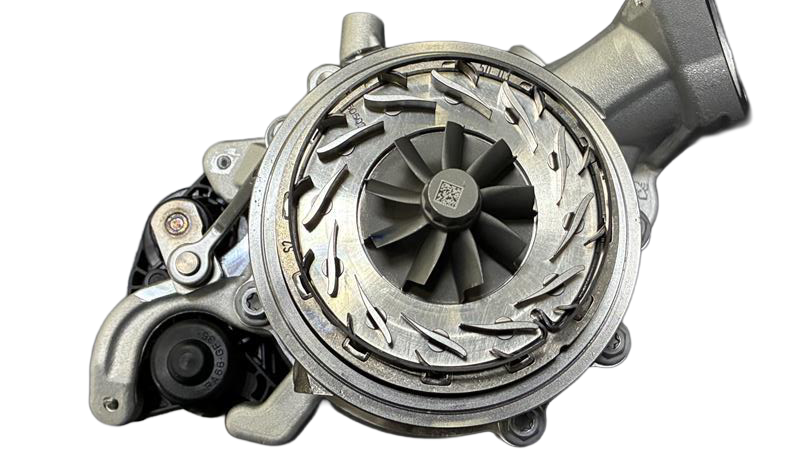
The turbocharger is one of the most leveraged components in a modern combustion engine. Get it wrong and the vehicle feels lethargic off-idle, runs out of breath at the top end, or both. Variable Turbine Geometry (VTG): also known as Variable Geometry Turbocharging (VGT), the term Garrett popularised, while BorgWarner and most European engineers use VTG, is one of the dominant techniques used to broaden a turbocharger’s operating range, particularly in diesel engines and increasingly in modern boosted-petrol hybrid applications. This explainer covers what VTG actually does, what the mechanical hardware looks like, what trade-offs you accept compared with fixed-geometry or twin-turbo designs, and where the technology is heading in hybrid powertrains.
A conventional fixed-geometry turbocharger is a compromise: the turbine housing’s aspect ratio (A/R) is sized for one operating point. Choose a small A/R and you get fast spool-up and strong low-end torque, but exhaust back-pressure rises sharply at high engine speed, turbine flow approaches choking conditions and pumping losses rise. Choose a large A/R and the engine breathes well at the top end but feels gutless until 2,500 rpm.
How Variable Turbine Geometry Works
A VTG turbo solves this by replacing the fixed nozzle ring with a set of pivoting vanes around the perimeter of the turbine wheel. An actuator — pneumatic, hydraulic or, on most modern units, electric — rotates the vanes in unison via a unison ring. Closing the vanes narrows the gap between them and forces the exhaust through a smaller flow area at higher velocity, accelerating spool-up. Opening the vanes lets more gas pass at lower velocity, supporting high-rpm power without choking the engine.
In effect, the VTG mechanism gives the engine an exhaust housing that resizes itself in real time. The control unit blends the vane position into the boost-control strategy alongside throttle, lambda, knock and (on petrol engines) a wastegate.
VTG vs Fixed-Geometry vs Twin-Turbo
The three dominant boost strategies trade off cost, weight, transient response and peak power. A VTG turbo can approach the low-rpm response of a smaller fixed-geometry unit while retaining much of the high-rpm breathing capability of a larger one, in a single package. The relative performance compared with a pair of fixed-geometry units depends on the specific engine, inertia, boost target and turbine sizing. A sequential twin-turbo can sometimes beat VTG at both extremes but at the cost of two compressors, two turbines, additional plumbing, more failure modes and significantly higher cost. For most modern downsized engines, a single VTG turbo is the best value engineering trade.
The exception is high-output diesel applications where exhaust pulse energy is high enough that a twin-stage fixed-geometry arrangement still wins on peak boost — but even there, modern VTG units increasingly close the gap.
Why VTG on Petrol Engines Used to Be Difficult
VTG has been standard in light-duty diesel turbos for two decades. Diesel exhaust runs cooler — typically 750–850°C at the turbine inlet — which is well within the temperature limits of the high-temperature alloys used for vanes, unison rings and bushings. Petrol exhaust gas can reach 950–1050°C, which historically caused thermal warping, sticking and accelerated wear in VTG mechanisms.
Two engineering shifts changed this. First, alloy and coating advances, MAR-M family nickel superalloys are widely used for the vane components themselves, with SiMo cast irons applied to turbine housings and related hot-side castings; bushing geometries and surface coatings have also improved, collectively bringing VTG hardware up to petrol exhaust temperatures. Second, some modern petrol engines run cooler-than-stoichiometric strategies (lambda > 1) at high load, particularly when combined with Miller-cycle valve timing, dropping peak exhaust gas temperatures into the regime that VTG mechanisms tolerate. The approach is architecture-dependent: many turbocharged petrol engines still enrich under high load for turbine protection.
Historically, the first production-gasoline VTG application was the Porsche 911 Turbo (997 generation, 2006), which used a BorgWarner / KKK variable-geometry unit on a relatively low-volume premium powertrain. BorgWarner’s 50 mm VTG turbocharger fitted to the Stellantis Hurricane 4 Turbo is one of the first modern high-volume mainstream petrol VTG applications. It also illustrates a related trick: it pairs VTG with a wastegate. The wastegate enables faster catalyst light-off during cold start (diverting a portion of exhaust flow around the turbine) while VTG provides the boost-control authority once the engine is warm. For more on this implementation see our coverage of the BorgWarner VTG turbocharger and the Stellantis Hurricane 4 Turbo engine.
VTG and the Miller Cycle
VTG’s ability to deliver high boost across a broader rpm range is what makes the Miller cycle workable on a petrol engine. Miller-cycle operation closes the intake valves early (or late) to reduce effective compression and lower peak in-cylinder pressure, allowing a higher geometric compression ratio without knock. The penalty is a smaller air charge per cycle — which the engine compensates for by running higher boost pressure.
Without VTG, supplying enough boost early enough to make Miller-cycle behaviour useful below 2,500 rpm is mechanically very difficult. With VTG, the vanes close at low engine speed to build boost before the air charge problem becomes severe. This pairing is one of the reasons VTG is increasingly attractive in boosted Miller-cycle petrol engines, although some Miller-cycle programmes still use twin-scroll fixed-geometry turbos or rely on hybrid torque-fill below the boost threshold.
VTG in Hybrid Powertrains
In a parallel hybrid, the e-motor handles transient torque demand below the boost threshold — the regime where a fixed-geometry turbo feels worst. That changes the requirements on the turbo: it no longer has to be small enough to spool from idle, only small enough to transition smoothly from e-motor torque to combustion torque around 1,500–2,000 rpm. VTG sized for that crossover delivers excellent driveability with minimal turbo lag — arguably better than most non-hybrid setups, because the e-motor covers the rare condition where VTG can’t.
Engineers integrating VTG with electrification often describe it as “the turbo finally gets to be sized for steady-state efficiency rather than transient response” — and that has measurable fuel-economy benefits in the WLTP cycle. ZF’s integrated 8HP Evo hybrid transmission is one example of how the rest of the driveline is being redesigned around this assumption.
Failure Modes and Service Considerations
VTG’s additional complexity has two practical consequences. The unison ring and vane bushings are the most service-sensitive parts — carbon and soot build-up can cause vanes to stick, which manifests as boost over- or under-shoot rather than outright failure. On older diesel applications, periodic sustained high-load operation at temperature helps burn off carbon deposits and free a stuck mechanism. Modern petrol VTG turbos run hotter, which incidentally helps keep deposits down.
The actuator is a second wear point. Vacuum and pneumatic actuators are simple but slow; modern electric VTG actuators are precise and fast but add a software failure mode. Electric VTG actuators on production engines now typically have closed-loop position feedback and are diagnosed via OBD-II.
Bottom Line for Engineers Specifying a Turbo
If your engine displaces between 1.0 L and 3.0 L, runs petrol or diesel, and needs strong torque from low rpm AND high specific power AND tight emissions compliance, a VTG turbo is almost always the right starting point. Where displacement gets larger or where two-stage boost is genuinely required for peak output, a sequential twin-turbo or compound boost arrangement may still be the right call. VTG is the default in modern diesel passenger vehicles and is increasingly common in premium and high-efficiency petrol engines, particularly hybrid-ready boosted-petrol applications, although twin-scroll fixed-geometry turbos remain the more common choice across the broader petrol market today.
Frequently Asked Questions
Variable Turbine Geometry is a turbocharger design in which the angle of the turbine vanes is actively varied with engine load and speed. By rotating a set of pivoting vanes around the turbine wheel, a single VTG turbo can deliver fast low-end torque AND sustained high-end power without the lag and packaging penalty of a twin-turbo arrangement.
An actuator (electric on most modern units) rotates the vanes via a unison ring. Closing the vanes narrows the flow area and accelerates exhaust gas onto the turbine wheel for fast spool-up. Opening the vanes lets more gas pass at lower velocity for high-rpm power without choking the engine. The control unit blends vane position into the boost-control strategy.
Petrol exhaust gas can reach 950–1050°C, which historically caused thermal warping and accelerated wear in VTG mechanisms designed for cooler diesel exhaust (750–850°C). Alloy and coating advances (MAR-M, SiMo materials) plus modern lambda-greater-than-1 and Miller-cycle strategies have brought petrol exhaust temperatures into the regime VTG mechanisms tolerate.
For most modern downsized engines, a single VTG turbo can approach the low-rpm response of a smaller fixed-geometry unit while retaining much of the high-rpm breathing capability of a larger one, in a single package. Sequential twin-turbos can sometimes beat VTG at both extremes but at the cost of two compressors, two turbines, additional plumbing and significantly higher cost.
In a parallel hybrid, the e-motor handles transient torque demand below the boost threshold. That lets the VTG turbo be sized for steady-state efficiency rather than transient response, delivering fuel-economy benefits in the WLTP cycle without compromising driveability.
Further Reading From the ATN Powertrain Library
- BorgWarner VTG turbocharger for the Stellantis Hurricane 4
- Stellantis Hurricane engine and Turbulent Jet Ignition
- EV vs Hybrid Powertrain: Which Fits Each OEM Strategy?
- Brake-By-Wire Explained: EMB and EHB Architectures
- Steer-By-Wire Explained
For more turbocharger technology news, click the link.
Source: BorgWarner Turbo Technologies.
For more turbocharger news, click here.
