

 By ATN Editorial Team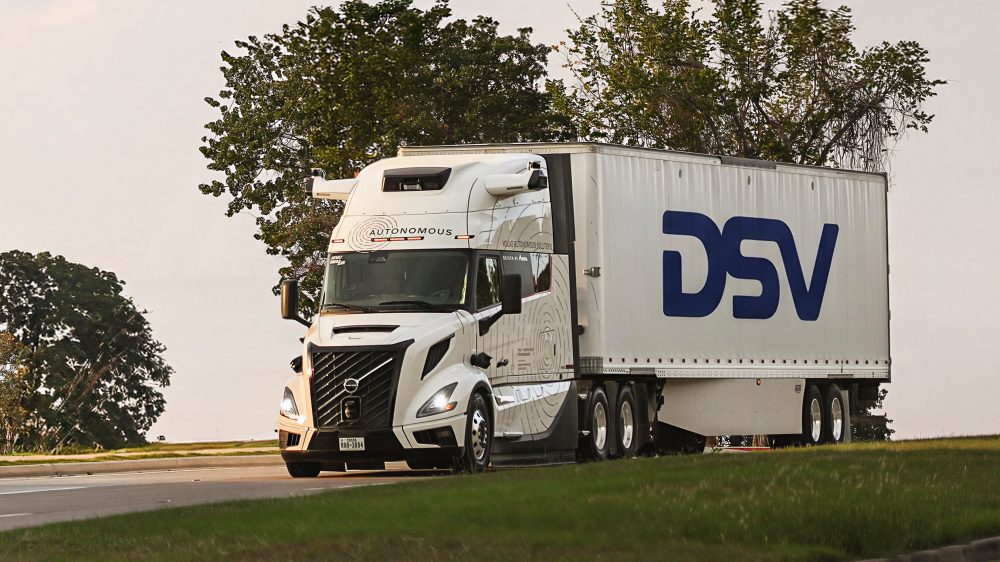
Summary: The Volvo VNL Autonomous has hauled its first commercial truckload for logistics provider DSV in Texas, marking the start of autonomous freight operations between Dallas and Houston. The purpose-built Volvo VNL Autonomous tractor is integrated with the Aurora Driver and runs as part of Volvo Autonomous Solutions’ Autona/freight ecosystem.
Key engineering takeaway: The Volvo VNL Autonomous was designed from the ground up for autonomous driving and is built for deployment in long-haul freight operations. It is integrated with the Aurora Driver, and Volvo’s Autona/freight setup combines the truck with self-driving technology from partners Aurora and Waabi. Initial operations run depot-to-depot between Aurora’s Dallas and Houston terminals, with a safety driver onboard during the first phase.
Why it matters: Logistics providers such as DSV are an important customer group for Volvo Autonomous Solutions, and DSV describes the Texas service as a production, depot-to-depot setup. Volvo Autonomous Solutions has logged more than 1 million regional and local freight miles since 2023; the DSV programme integrates the Volvo VNL Autonomous into DSV’s existing logistics flows, with the ambition to add more lanes over time.
Volvo Autonomous Solutions (V.A.S.) and DSV mark the start of autonomous freight operations in Texas, with the first commercial truckload hauled using the Volvo VNL Autonomous, and with the ambition to expand to additional lanes over time.
Designed from the ground up for autonomous driving and integrated with the Aurora Driver, the Volvo VNL Autonomous is built for deployment in long-haul freight operations. The collaboration builds on the long-standing relationship between Volvo and DSV, grounded in safety, performance and progress toward transforming logistics. With DSV as the market-leading logistics provider, the collaboration also shows how autonomous transport can be integrated into complex, large-scale logistics networks to strengthen efficiency, asset utilization and supply chain resilience.
Volvo VNL Autonomous Begins DSV Long-Haul Service In Texas
V.A.S. is launching autonomous transport services for DSV between Aurora’s terminals in Dallas and Houston, integrating them into DSV’s existing logistics flows. During the initial phase, a safety driver will be present in the vehicle, in line with Volvo’s current operational mode.
“Autonomous driving is moving towards real-world operations,” said Helmut Schweighofer, CEO, DSV Road. “Our collaboration with Volvo in Texas represents a production, depot-to-depot setup. We see clear opportunities to improve safety and driver comfort, help mitigate a growing driver shortage, and unlock better asset utilization through 24/7 operations for the benefit of our customers.”
“Logistics providers like DSV are an important customer group for Volvo Autonomous Solutions, and DSV is at the forefront of how autonomous transport can be applied in real logistics networks,” says Sasko Cuklev, Head of On-Road Solutions at V.A.S. “Starting between Dallas and Houston, we plan to move freight together in a way that supports round-the-clock operations and creates a scalable foundation for adding more lanes over time.”
Inside The Autona/Freight Ecosystem
As part of the collaboration, Volvo Autonomous Solutions will deploy its Autona/freight solution for DSV. Autona/freight is Volvo’s end to end autonomous transport setup, combining the Volvo VNL Autonomous with self-driving technology from partners Aurora and Waabi, as well as the systems and services needed to operate and manage autonomous freight at scale.
With more than one million miles logged in regional and local freight since 2023, V.A.S. brings significant operational experience that supports reliable scaling with logistics providers like DSV.
For more autonomous driving news, click here.
