

 By ATN Editorial Team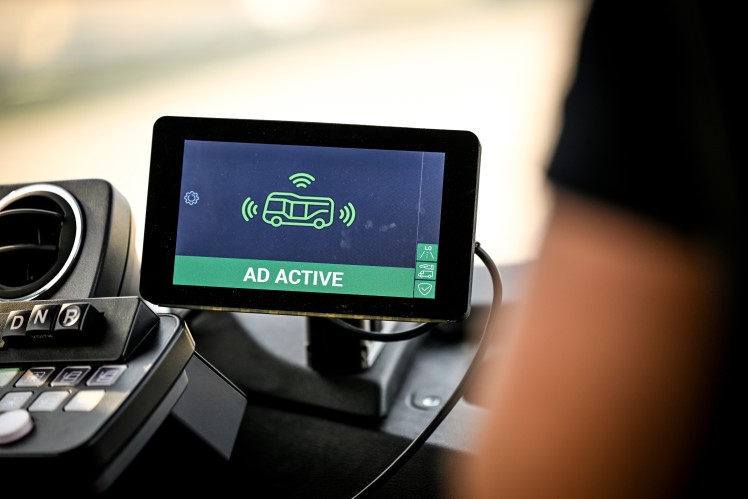
ZF Mobility Solutions has received approval from the German Federal Motor Transport Authority (KBA) to test a Level 4 system for autonomous driving (AD) on public roads throughout Germany. Previously, the individual approvals granted applied to clearly defined stretches of road or urban areas. The approval marks a milestone in the development of autonomous mobility solutions: As a development and consulting service provider, the ZF subsidiary can now support partners more quickly and efficiently in the implementation of sustainable transportation turnaround projects for local public transport. For the first time, ZF Mobility Solutions used the extended approval for a project in North Rhine-Westphalia: On behalf of Rheinbahn AG, the short-term use of an autonomous transportation system (ATS) was tested in Düsseldorf.
“The Germany-wide Level 4 test approval for our autonomous driving system marks a significant step towards autonomous mobility in local public transport. The KBA approval is a catalyst for the use of autonomous transport systems throughout Germany, and therefore also for the entire industry,” says Alexander Makowski, Head of ZF Mobility Solutions.
“We can now test autonomous mobility systems in a wide variety of environments – from urban centers to rural regions. In the future, we will no longer need a separate test permit for this. This saves our customers time and money. They can now implement urban and regional transport projects faster, more cost-optimized and more efficiently,” explains Makowski.
Pioneering approval for highly automated driving
The test approval provides important findings for the further development of autonomous mobility solutions, whose use offers potential for greater safety, efficiency and sustainability in traffic. It helps to bring the technology to market maturity and further develop operational framework conditions. The focus here is on public – and therefore urban and regional – local passenger transport. Freeways, motorways and roads with a maximum permitted speed of more than 100 km/h are therefore excluded from the approval. The permit is valid until the end of 2026 and can then be extended until the end of 2028.
Successful ATS deployment with Rheinbahn AG in Düsseldorf
The first ATS deployment following the extended approval took place in North Rhine-Westphalia in February. In Düsseldorf, ZF Mobility Solutions tested the short-term use of an autonomous mobility solution with a safety driver on public roads on behalf of Rheinbahn AG. As part of XPONENTIAL, the leading trade fair for autonomous technologies and robotics, and the subsequent customer days, public transport operators and representatives of cities and municipalities were given the opportunity to ride in an autonomous transport system. Interested visitors were also able to register for the free test drives between the trade fair parking lot and the exhibition halls
“Autonomous driving is a crucial building block for the transport transition and a further step towards seamless, inclusive and sustainable mobility. The recent nationwide approval strengthens our resolve to go further into practical implementation with partners, to learn together and to drive forward innovative mobility solutions,” says Annette Grabbe, Spokeswoman of the Executive Board, Labor Director and CFO of Rheinbahn AG.
ZF Mobility Solutions supported Rheinbahn AG in the implementation of the autonomous public transport trial. The focus is on the organizational and technical qualification of operations. Specifically, this involves advisory activities in the selection and evaluation of potential routes, mapping them and drawing up the requirements profile for hardware and software. ZF Mobility Solutions is also responsible for commissioning, carrying out the trials and subsequently interviewing the test subjects for the development.
Baden-Württemberg: RABus pioneers in autonomous driving
ZF Mobility Solutions has already gained experience and development expertise in the context of highly automated driving functions and knowledge of approval and licensing processes for Level 4 vehicle platforms in the RABus project. For two selected routes in the cities of Friedrichshafen and Mannheim in Baden-Württemberg, the project partners were one of the first to receive a Level 4 test approval from the KBA last year in accordance with the nationally applicable Autonomous Vehicle Approval and Operation Ordinance (AFGBV).
In accordance with the AFGBV, the consortium partners specifically developed a shuttle for the RABus project that meets the technical requirements of mixed traffic. To this end, the technology group ZF has entered a project-related partnership with the shuttle manufacturer eVersum from Austria, which is supplying four electric shuttles for the project that have been equipped with the latest AD technology from ZF.
The project, funded by the Baden-Württemberg Ministry of Transport, was extended by Minister Winfried Hermann at the end of last year at Friedrichshafen. The ZF subsidiary is using the extended project duration to further advance technical development and create additional testing opportunities to further optimize the ZF system used for autonomous driving under real-life conditions.
“With RABus, Baden-Württemberg has done pioneering work in autonomous driving with shuttle buses. For me, the nationwide approval to operate the RABus throughout Germany is a kind of accolade for the project. The findings from the state are now helping to further develop autonomous mobility systems nationwide and bring them closer to market maturity at SAE Level 4. I am particularly pleased that North Rhine-Westphalia and its project partners are also driving this topic forward and pulling together with us. This is creating valuable synergies that will strengthen autonomous public transport in Germany as a whole. In Baden-Württemberg, we are also continuing to work on laying the foundations for this intelligent technology,” says Winfried Hermann, Minister of Transport for Baden-Württemberg.
“In Baden-Württemberg, we have tested and proven the use of autonomous mobility systems in real operation in the RABus project,” says Alexander Makowski. “Other cities and municipalities can now benefit from this expertise.”
For more autonomous mobility technology news, click here.
