

 By ATN Editorial Team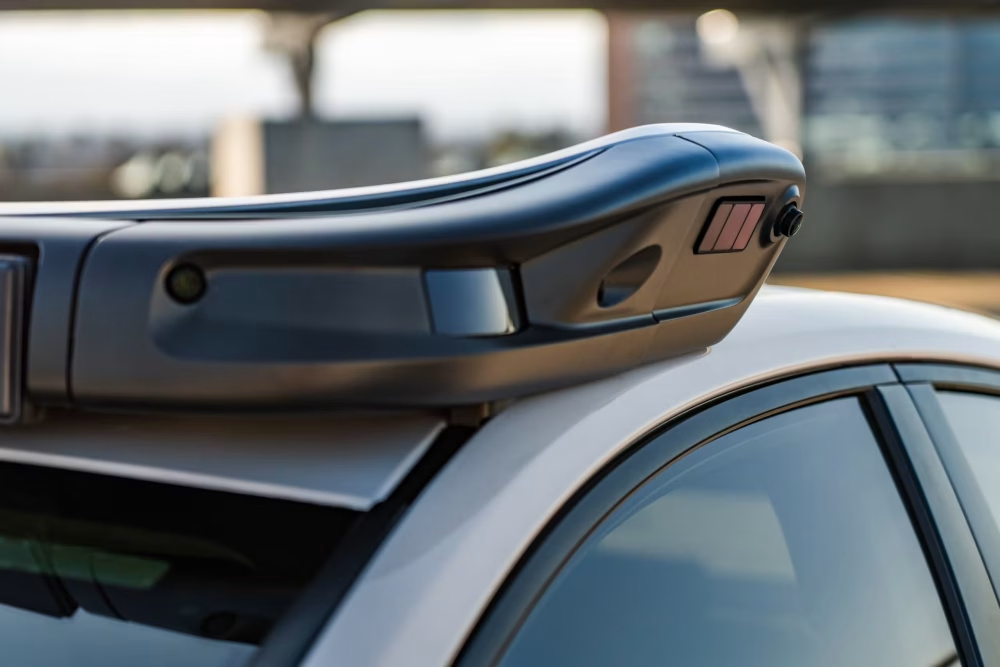
Summary: Nuro has unveiled the latest generation of its Driver sensor architecture, designed to offer high performance, improved safety, and seamless scalability. The system features a compact, modular design with automotive-grade cameras, lidar, radar, and environmental sensors that provide 360-degree perception, reduce cost, and enable easy integration across a range of autonomous vehicle platforms.
Auto Tech View:
- Modular, low-profile sensor suite optimised for scale, aerodynamics, and seamless vehicle integration
- 360-degree perception achieved through four specialised camera types, solid-state lidar, and high-resolution imaging radar
- ASIL-D certified IMU and enhanced audio detection support critical safety features and road-sharing awareness
- Solid-state sensor choices and fewer moving parts improve reliability, manufacturability, and commercial readiness for L4 autonomy and beyond
Today, we’re excited to share more about the latest generation of the Nuro Driver’s sensor architecture, engineered to offer unmatched safety, performance, and scalability.
Built for Effortless Scale
When most people imagine a self-driving car, they picture a vehicle covered in large, spinning sensors. While these autonomous vehicles certainly work, they’re difficult to manufacture at scale: custom sensors are expensive, require ongoing specialized maintenance, and must be reconfigured to integrate with new vehicle platforms.
The latest iteration of the Nuro Driver’s sensor architecture is built for scale with advanced and robust commercially available automotive-grade sensors that ensure high performance and reliability at lower operational costs. A new modular design enables swift, seamless integration with diverse vehicle platforms and supports various levels of autonomy for different applications—from L2+ ADAS-equipped personal vehicles to fully autonomous L4 robotaxis and goods delivery vehicles.
Unlike the elevated arched design you see on our vehicles today, the Nuro Driver’s new sensor architecture keeps a low profile, providing improved performance in a much smaller footprint. Not only does this compact arrangement smoothly blend with any style of vehicle, it also translates to better aerodynamics for high-speed driving and fewer potential visual obstacles for other road users.
A New and Improved Sensor Architecture
Cameras, lidar, and radar sensors are arranged to provide a redundant, 360-degree field of view for maximum scene detection and safety, allowing the Nuro Driver to see more, better, and farther.
Four Kinds of Cameras:
Ultra-long-range, long-range, short-range, and traffic light-detection cameras give the Nuro Driver critical information about colors and lane markings. Our ultra-long-range camera has a 30-degree horizontal field of view that allows the Nuro Driver to detect extremely small objects at great distances—a crucial feature for highway driving. Our updated cameras are 24-bit HDR, mitigating LED flicker and enhancing visibility in challenging lighting conditions like dawn and dusk.
State-of-the-Art Lidar:
Long- and short-range lidar sensors provide the Nuro Driver with precise distance and depth information. Instead of traditional rotary lidar sensors, we have adopted small solid-state lidar with enhanced long-range detection and improved side and rear visibility. This update also means our sensor architecture has fewer moving parts, making it more reliable and much easier to manufacture.
Highway-Capable Radar:
Long-range, high-resolution imaging radar sensors allow the Nuro Driver to detect the distance and depth of small, far-away objects, even in harsh weather conditions. Additional radar sensors provide long-range elevation information with higher velocity and angular resolution, enhancing the Nuro Driver’s ability to detect and react to high-speed vehicles and cross-traffic.
Environmental Sensors:
Our next-gen sensor architecture contains a microphone with upgraded audio processing to detect emergency vehicle sirens, and an improved inertial measurement unit (IMU) that is rated Automotive Safety Integrity Level D (ASIL-D), which is the highest level of safety integrity for automotive systems. These two sensors ensure the Nuro Driver shares the road safely and responsibly.
Prepared for the Road Ahead
To ensure peak performance no matter where the Nuro Driver goes, the sensors that make up the newest generation of our sensor architecture have undergone rigorous validation and testing, both in our lab and on the field. All of the new sensors showed significant improvements in challenging weather conditions and long-distance detection of road debris, animals, and vulnerable road users like cyclists.
The Nuro Driver’s next-gen sensor architecture is a significant leap forward, providing higher resolution, extended range, enhanced robustness, and greater modularity. Its improved capabilities will allow the Nuro Driver to perform safely and reliably in more complex and diverse environments as we expand our operations.
We are thrilled to offer our partners a self-driving system that meets the highest performance standards and enables economies of scale for broad deployment on all roads and all rides.
For more sensor technology news, click here.
