

 By ATN Editorial Team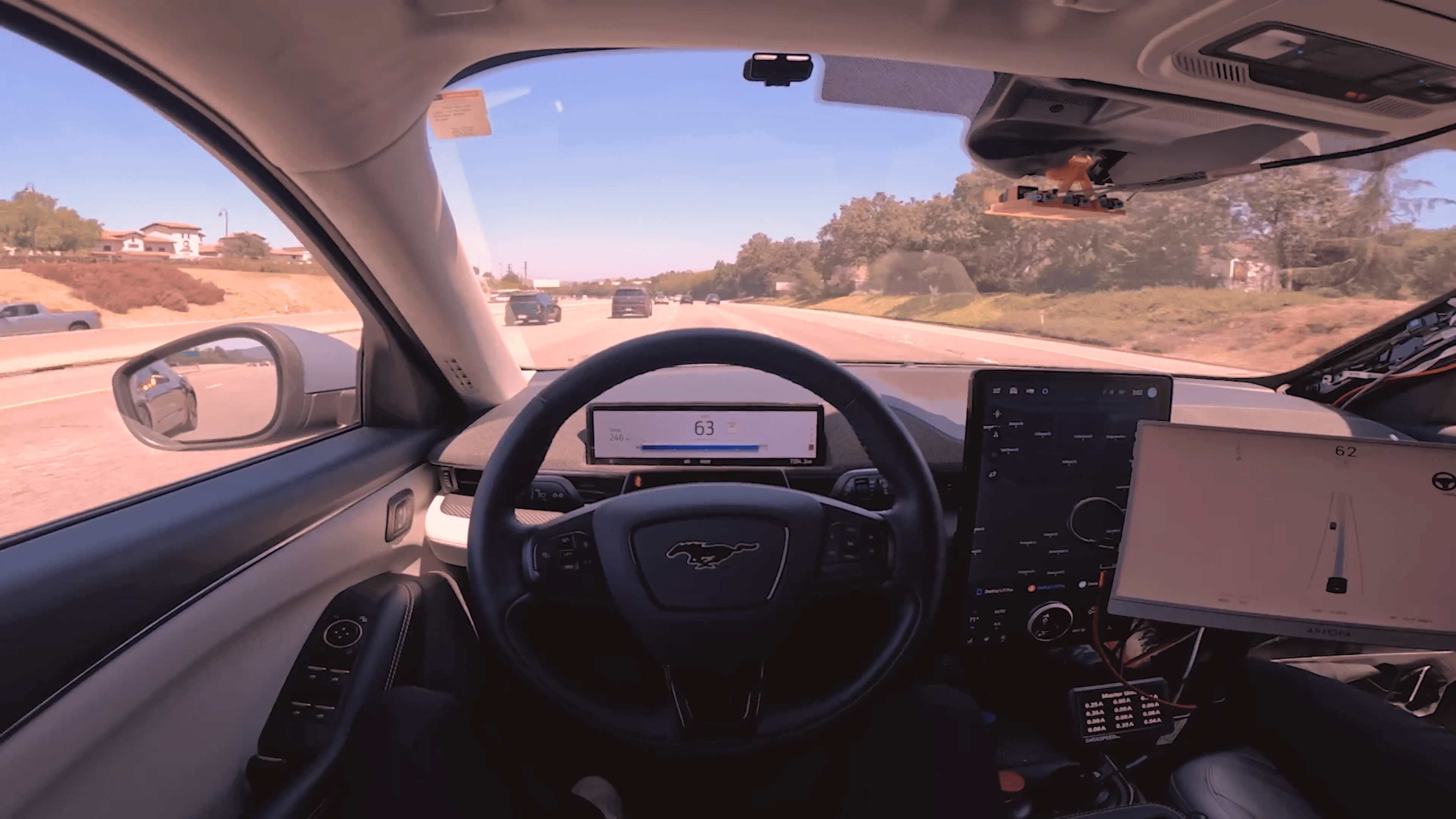
Summary: IDrive has launched IDrive Autonomy Assisted Driving, a licensable L2+ driver assistance stack aimed at carmakers that want supervised automation without building an autonomy system themselves. It is available for licensing now and is running on a demonstration production vehicle.
Key engineering takeaway: IDrive says the complete stack costs approximately $1,500 in hardware, made up of two cameras, an inertial measurement unit and compute, with the cameras fitted behind the rear-view mirror and no vehicle modification required. The company describes it as a single learned driving system rather than a set of separate functions, and reports more than 1,100 engaged miles on public roads at an engaged top speed of 70 mph.
Why it matters: The cost claim is the part worth testing. A licensable L2+ driver assistance stack at that bill of materials sits an order of magnitude below multi-sensor systems built around radar and lidar, and IDrive argues the liability boundary, not the perception problem, is what keeps supervised automation commercially tractable.
IDrive today announced the launch of IDrive Autonomy Assisted Driving, a low-cost, licenseable L2+ driver-assistance platform designed to give automotive companies a practical path to deploying advanced driving assistance without having to build an autonomous-driving system from the ground up.
The company is positioning L2+ as the industry’s practical sweet spot: sophisticated enough to deliver meaningful driving automation on everyday roads, while keeping the human driver responsible for the vehicle. IDrive Autonomy is available for licensing now and is already operating on a production vehicle for real-world demonstration.
The announcement comes as automakers face a difficult choice in advanced driver assistance. Traditional L2 systems can be limited, fragmented and difficult to improve after launch, while pursuing true full self-driving is an extraordinarily difficult engineering, validation and liability challenge.
The industry has spent years chasing the dream of full self-driving, but FSD is an entirely different problem. You are not just solving a perception and driving problem, you are taking on an enormous safety, validation, regulatory and liability burden. That makes a fully autonomous system extremely difficult to commercialize and even harder to license as a general-purpose product. We believe L2+ is where the real opportunity is today. Automakers want better driver assistance, but they don’t want to reinvent the entire autonomy stack.
Raghu Kulkarni, CEO, IDrive
Why IDrive Is Targeting L2+ Rather Than Full Self-Driving
Achieving reliable full self-driving across virtually every road, weather condition and unpredictable driving scenario requires solving an enormous number of edge cases. It also changes the liability equation: when a vehicle is expected to drive without human responsibility, the technology provider and vehicle manufacturer face substantially greater consequences when the system fails.
That makes a turnkey, general-purpose FSD stack exceptionally difficult for an automotive company to simply license and deploy. L2+ offers a fundamentally different model.
The driver remains responsible and supervises the system, while the vehicle handles increasingly sophisticated tasks such as lane keeping, adaptive cruise control, stop-and-go driving and lane-change assistance. Companies can therefore deliver a significantly more capable driving experience without taking on the same technological and liability burden associated with fully autonomous operation.
L2+ is the sweet spot. Companies are already trying to deliver it, but the market lacks a compelling solution that is low-cost, adaptable, transparent and actually available as a layer they can license and ship. That’s the gap IDrive Autonomy is designed to fill.
Raghu Kulkarni, CEO, IDrive
What The L2+ Driver Assistance Stack Does Today
IDrive Autonomy is built as a single learned driving system rather than a collection of disconnected driver-assistance functions. The system is designed for ordinary driving environments, including urban streets, open freeways and mixed traffic. Current capabilities include:
- Lane keeping through curves
- Adaptive cruise control
- Stop-and-go traffic management
- Lane-change assistance
- Object and lead-vehicle tracking
- Lane-departure warnings
- A real-time driver display showing what the system sees
The system is currently being demonstrated on public roads, with more than 1,100 real-world miles engaged, more than 25 hours of engaged driving, and an engaged top speed of 70 mph. IDrive says system changes are evaluated with a safety driver on the road and in simulation, with driving data feeding back into the underlying model.
A Two-Camera, $1,500 Hardware Footprint
IDrive has designed the system around a deliberately lean hardware configuration rather than expensive, specialized sensor suites. The complete assisted-driving stack is approximately $1,500 in hardware, consisting of:
- Two cameras
- An inertial measurement unit (IMU)
- Compute
The cameras can be installed behind the rearview mirror without modifying the vehicle, providing a universal-fit approach intended to simplify integration across vehicle platforms.
One Model, Three Stages: The Roadmap Beyond L2+
While IDrive Autonomy is launching with L2+ assisted driving, IDrive has designed the underlying technology with a longer-term autonomy roadmap in mind.
The company’s roadmap progresses through three stages: Assisted Driving, Collaborative Driving and, ultimately, Robotaxi applications. The immediate focus is Stage 1, delivering practical L2+ capabilities today, while continuing research toward increasingly autonomous driving systems.
IDrive describes the approach as “one model, three stages”, allowing experience and data from real-world driving to contribute to future system improvements. IDrive Autonomy Assisted Driving is available now for automotive companies interested in licensing and integrating the technology into their vehicle platforms.
Frequently Asked Questions
What is L2+ driver assistance?
L2+ driver assistance is an industry shorthand, not an SAE tier. Everything sold under it remains SAE J3016 Level 2, with the driver legally responsible and required to supervise continuously. The “plus” signals a wider capability set than basic Level 2, typically covering lane keeping through curves, stop-and-go traffic and automated lane changes rather than simple lane centring and adaptive cruise control.
What is the difference between L2+ and full self-driving?
The difference is responsibility rather than capability alone. Under L2+ the driver supervises and remains liable, so the system can hand back at any time. A system that drives without human responsibility must resolve a far larger set of edge cases and moves the safety, validation and liability burden onto the technology provider and the vehicle manufacturer. IDrive argues that this is what makes a general-purpose full self-driving stack difficult to license and commercialise.
What hardware does IDrive Autonomy need?
IDrive says the complete assisted-driving stack is approximately $1,500 in hardware, consisting of two cameras, an inertial measurement unit and compute. The cameras are installed behind the rear-view mirror without modifying the vehicle, which the company presents as a universal-fit approach across platforms.
What can the IDrive Autonomy system do?
The listed capabilities are lane keeping through curves, adaptive cruise control, stop-and-go traffic management, lane-change assistance, object and lead-vehicle tracking, lane-departure warnings and a real-time driver display showing what the system sees. IDrive reports more than 1,100 engaged miles and more than 25 hours of engaged driving on public roads, at an engaged top speed of 70 mph.
Is IDrive Autonomy available to license?
Yes. IDrive says the platform is available for licensing now and is already operating on a production vehicle for real-world demonstration. The company describes a three-stage roadmap running from assisted driving through collaborative driving to robotaxi applications.
Further Reading On Auto Tech News
- Level 2++ ADAS From CARIZON Enters Series Production In China
- Astemo And TIER IV To Develop End-To-End Autonomous Driving AI
- TIER IV And Renesas Build An AI-Native Computing Platform
- What Is An Image Signal Processor (ISP)? An Engineer’s Guide
For more ADAS news, click here.
