

 By ATN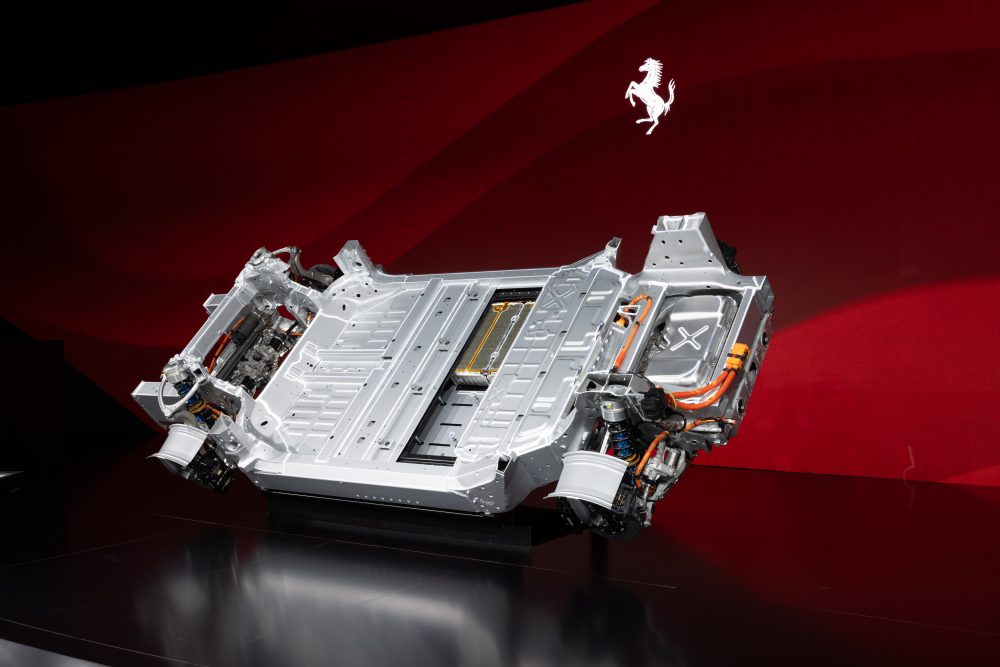
Summary: Ferrari has unveiled the production-ready chassis and components of its first fully electric car, the Ferrari Elettrica. Developed entirely in-house, the model integrates Ferrari’s race-derived engineering expertise into an all-new platform that prioritises driving emotion, performance, and sustainability. The Elettrica introduces a 75% recycled aluminium chassis, four in-house electric motors delivering up to 930 kW combined power, and an 800 V structural battery pack with class-leading 195 Wh/kg energy density.
Key engineering takeaway:
Ferrari has built a fully integrated, in-house EV architecture from the ground up, featuring structural batteries, F1-derived Halbach array rotors, and a carbon-sleeved motor design that pushes energy density and control precision to new limits.
Why it matters:
The Elettrica demonstrates how high-performance EVs can deliver both driving emotion and efficiency through advanced integration of powertrain, chassis, and control systems — setting a new engineering benchmark for electrified supercars.
Ferrari reveals the production-ready chassis and components of its new electric car, the first full-electric model in the history of the Prancing Horse, the Elettrica. This model is a milestone in the brand’s multi-energy strategy, which encompasses internal combustion engines, HEV and PHEV powertrains, and now, fully electric drive.
The project is now ready to go into production and boasts over 60 patented proprietary technological solutions. For the first time, both the chassis and bodyshell are manufactured with 75% recycled aluminium, contributing to an astonishing overall saving of 6.7 tons of CO2 for every vehicle built.
The architecture features short overhangs, an advanced driving position close to the front axle, and a battery integrated completely into the floorpan. The modules are installed between the front and rear axles, with 85% of them concentrated in the lowest position possible to lower the centre of gravity and benefit driving dynamics. Notably, the Ferrari Elettrica gains a dynamic edge from a centre of gravity 80 mm lower than an equivalent ICE model.
At the rear, Ferrari has introduced the first separate subframe in its history. It has been designed to reduce noise and vibration perceived in the cabin while still ensuring the stiffness and driving dynamics expected from a car from Maranello. The third generation of the 48 V active suspension system – originally introduced on the Purosangue and evolved for the F80 – takes ride comfort, body control and vehicle dynamics to even greater heights by distributing cornering forces optimally over the four wheels.
The first all-electric Ferrari is equipped with two electric axles developed and built entirely in-house, each with a pair of synchronous permanent magnet engines and Halbach array rotors derived from F1 technology and industrialised for a series production application. The front axle has a power density of 3.23 kW/kg and an efficiency of 93% at peak power, while the rear axle attains a power density of 4.8 kW/kg and the same peak efficiency. Capable of delivering up to 300 kW, the front inverter is fully integrated into the axle and weighs just 9 kg.
Designed and assembled in Maranello, the Ferrari Elettrica’s battery has an energy density of almost 195 Wh/kg – the highest of any electric car – and features a cooling system designed to optimise heat distribution and performance.
E-AXLES
The front and rear axles comprise two independent electric engines each, which work in concert to enable torque vectoring and improve the car’s dynamic behaviour.
Every part of both the front and rear axles of the Elettrica was developed entirely in-house by Ferrari to attain the extraordinary performance typical of the marque. The transmission, inverters and electrical engines are all designed for total control, superlative power density, extreme electrical efficiency and low noise emissions. Fabricating the castings in-house in Ferrari’s own foundry also ensures impeccable build quality allowing the company to keep the entire production process under tight control. All castings are produced with secondary aluminium alloy, a choice that let us cut CO₂ emissions by up to 90% compared with conventional alloys with no compromise in mechanical performance.
The front axle, with a total power output of 210 kW, can be decoupled at any speed (up to top speed) to transform the car to rear-wheel drive and maximise efficiency and consumption in driving situations where four-wheel drive isn’t needed. Under full acceleration, the axle can deliver up to 3500 Nm to the wheels.
The unparalleled lightness and compactness of the axle were made possible by integrating its components, and all the power electronics are installed directly on the axle. As well as reducing overall dimensions, this choice also improves efficiency and power density: the front axle achieves a power density of 3.23 kW/kg, and an efficiency of 93% at peak power output.
The outputs of the front and rear axles of the Ferrari Elettrica are asymmetric: the rear axle has a maximum power output of 620 kW, equating to a density of 4.8 kW/kg, and an efficiency of 93% at peak power output. The maximum rear torque transferrable to the tarmac is a staggering 8000 Nm in Performance Launch mode.
The front axle includes the disconnect system, which decouples the electric engines completely from the wheels to strike the ideal balance between efficiency and consumption. In the eManettino position for highway driving, the car is in pure rear-wheel drive mode. When dynamic conditions also call for traction from the front axle, the system automatically engages the two front engines and enables all-wheel drive. In the other two eManettino positions, the Electric Ferrari is in all-wheel drive configuration at all times.
The all-new disconnect system employs sophisticated gear synchronising technology borrowed from today’s state-of-the-art transmissions. The results are astonishing: the system is 70% lighter than the previous generation and can engage or disengage the engines in just 500 milliseconds. A solution combining lightness, efficiency and driving pleasure.
The Ferrari Elettrica’s axles are lubricated by a circuit delivering exactly the right amount of oil to keep the gears and mechanisms in the ideal condition for maximum efficiency. The dry sump lubrication system consists of a pump and a heat exchanger integrated into the axle. The circuit uses a main valve to activate the lubrication and deliver the pressure necessary for the actuators. Two additional valves manage the disconnect function and engagement and disengagement of the park lock on the rear axle. This architecture contributes to simplifying and reducing the overall weight of the system.
ELECTRIC ENGINES
The development of the Ferrari Elettrica’s permanent magnet synchronous engines equipping the axles pushed current technology to its limits. The motorsport heritage shows: the impressive torque and power density figures were achieved with sophisticated design and minute attention to every detail, optimised geometry and the use of materials offering the best performance.
High rotational speeds – 25,500 rpm at the rear and 30,000 rpm at the front – allow these engines to deliver a peak power of 310 kW and 105 kW respectively, but with compact dimensions enabling a space-saving axle architecture. The rotor employs surface-mounted permanent magnets, segmented for higher efficiency, while the motorsports-derived Halbach array configuration directs the magnetic flux towards the stator to maximise torque density and reduce overall weight.
The stator, on the other hand, features ultra-thin (0.2 mm) non-oriented grain silicon-iron laminations, stacked with a self-bonding process to minimise the probability of short circuits between the individual laminations. The concentrated winding stator configuration minimises end winding height, while the connections of the individual teeth are soldered to a compact and efficient terminal block. A Litz wire configuration is used to minimise losses in the windings caused by the skin and proximity effects. This advanced solution ensures optimal performance even in very high-frequency conditions with large phase currents.
To improve heat transfer from the copper windings to the external cooling circuit, the stator is fully vacuum-impregnated with a high thermal conductivity resin offering a thermal conductivity 40 times higher than air. This resin also improves the mechanical strength of the stator allowing it to better withstand the stress of operation.
The dynamic performance capabilities of these engines are astonishing: with a maximum angular acceleration of 45,000 rpm/s, the front engines spin up from stationary to maximum speed in under one second. This ensures that the system is not just powerful but also instantly responsive.
These extraordinary results were also made possible by industrialising processes which, until now, were the domain of prototype production: to counter the centrifugal forces experienced at high speeds, 1.6 mm thick carbon sleeves weighing just a few grammes are press-fit into the rotor to safeguard the integrity of the magnets with only a negligible impact on weight and virtually no increase in the rotor-stator air gap. The carbon sleeves hold the magnet in place just 0.5 mm from the stator and are capable of withstanding extreme mechanical stress: at 30,000 rpm, the individual magnets on the front rotor, while weighing just 93 grammes, generate a centrifugal force equating to a pressure of 390 bar (or 2.7 tons).
The result is an extremely compact and very high-performance electric engine which Ferrari has thus been able to fit to both the Ferrari Elettrica and the front axle of the F80 supercar, the model this solution was first developed for.
BATTERY
Designed and assembled completely in-house by Ferrari, the battery has been integrated into the floorpan, lowering the centre of gravity by 80 mm over an equivalent ICE model.
The centre zone of the car was developed with an integrated optimisation approach to both minimise the weight and increase the stiffness of the battery/chassis system.
The layout of the cells is designed to minimise inertia and lower the centre of gravity, placing them where possible behind the driver seat. 85% of the weight of the modules is situated under the floorpan, while the remainder is located under the rear seat: a solution that made it possible to shorten the wheelbase and minimise inertia to maximise driving pleasure in all situations, with an optimal weight distribution of 47–53%.
The layout of the front seats is designed to accommodate the cells without sacrificing any space for the rear occupants and ensured the distribution of the cells without compromising the centre of gravity of the car. The driver’s seat was positioned further forwards also redefining the layout of the rear seats, which are more reclined, to offer even better on-board comfort.
The aim to reduce weight was pursued with a global structural approach, shifting some of the protection function from the battery pack to the car’s body. So the chassis itself also protects the cells, which are placed as far as possible from zones exposed to the risk of impact. The gap between the cell and the sill acts as an energy-absorbing crumple zone and also houses the cooling lines. The same principle was also applied for front and rear crash protection: the cells in the battery module itself are concentrated in the middle, with the area around them used as energy-absorbing zones to protect the cells and minimise inertia. To ensure protection against accidental impact from underneath, the cells are suspended from the floor, a solution that created an energy-absorbing gap and let us minimise the weight of the protective shield. The result is a very thin aluminium shell structure, an element made even more efficient on the car by integrating the cooling plates into it: the cooling water contributes to keeping the centre of gravity low and to absorbing energy in the event of an impact, with no compromise in safety.
The transverse elements ensuring the stiffness and strength of the system are the die-cast compression plates of the cells themselves, which also incorporate the fastener points for fixing the battery to the chassis.
This means that the battery is no longer an independent block: it follows Ferrari’s philosophy of making total integration central to all development, becoming a structural element that has been pared down to the absolute essential with just two shells. Once fastened to the chassis (with 20 central anchor points), the lower shell contributes actively to the stiffness of the bodyshell. This is the opposite approach to the previous generation of monolithic batteries, and this let us set record-breaking numbers: an energy density of almost 195 Wh/kg, and a power density of approximately 1.3 kW/kg, which are both best-in-class figures. The result is one of the most competitive battery/chassis systems in the world, and it was entirely designed and manufactured in-house at Maranello. The concept of integration has been taken to the extreme, but without compromising serviceability and the ability to replace the battery and/or its components if needed, so that the Ferrari Elettrica model will also meet Ferrari’s uncompromising approach to building cars that will last forever.
The cooling system consists of a set of internal pipes and three cooling plates (two fastened to the housing plus a smaller pipe cooling the upper modules). Multiple flows are handled in a single metal unit, with both delivery and return flows fed through the same cooling plate to ensure uniform temperature and longer cell life. While contained within the battery itself, the battery cooling circuit is integrated completely into the primary vehicle cooling system, and incorporates the coolant flows for other components from the front of the car to the rear and vice versa.
The 15-module configuration (six dual rows, one single row and two upper modules) makes optimal use of the available space without lengthening the wheelbase, to the benefit of the agility of the car. Each module contains 14 resistance-welded cells separated by insulating partitions and conductive metal partitions, while thermal paste applied to the modules and the cooling plates optimises heat management. The cells, with an energy density exceeding 305 Wh/kg and a capacity of 159 Ah, were developed specifically to meet the high-performance targets for this application.
Integrated in each module is a flex PCB and an electronic control unit (CSC) installed on board the module itself, which dialogues with the Battery Management System (BMS) housed in the E-Box. Both the CSC and the BMS were developed in-house at Maranello with proprietary algorithms and operating strategies. As well as the BMS, the E-Box also contains fuses, relays and sensors, and manages both electrical power and communication over the car’s CAN line. Rated operating voltage is approximately 800 V, with 210 cells in series, with a peak current of up to 1200 A and RMS values up to 550 A. The system is protected by a main fuse capable of cutting current in just 3 milliseconds in the event of short-circuits – whether inside or outside the battery – exceeding 2000 A.
The battery’s internal connections and front and rear connectors allow it to supply power to both the front and rear inverters, as well as all auxiliary systems, without requiring extensive external cabling along the vehicle. Sized for the currents involved, the central busbars form safe and reliable electrical connections even in very tight spaces without reducing conductor cross-section. Attention to detail can be seen in every solution applied, demonstrating how each design choice follows the same philosophy of uncompromising efficiency, lightness and performance.
The Ferrari Elettrica’s battery is designed to be removable and repairable if needed. It can be removed using a dedicated carrier to allow modules or electronic battery components to be replaced without damaging structural elements or the finish of the car.
INVERTERS
The Elettrica’s inverters are another example of Ferrari engineering taking drivetrain technology to the limit, combining extreme performance with compact dimensions and total control. The inverters transform the DC high voltage electrical energy of the battery into AC current for powering the electric engines and, conversely, transform the energy recovered by regenerative braking from AC to DC to recharge the battery pack.
The front inverter is integrated directly in the front axle to save space and weight, and controls both of the front engines simultaneously, delivering up to 300 kW of overall power while weighing just 9 kg. The heart of this system is the Ferrari Power Pack (FPP), an integrated power module containing all the components needed for very high-performance power conversion in an extremely compact package: namely, six modules in silicon carbide (SiC), gate driver boards and an integrated cooling system.
The driver board is the interface between the high- and low-voltage sides and manages the behaviour of the power MOSFETs. Each board drives three modules, each consisting of 16 MOSFETs, which, alongside the integrated 800 V – 48 V DC/DC converter, ensure precision and responsiveness in the distribution of torque to the pair of engines. The inverter switching frequency, which varies from 10 to 42 kHz depending on the specifications of the application, has been painstakingly calibrated to balance efficiency, acoustic comfort and heat management, and to optimise engine response without compromising the overall integration of the system. Higher frequencies allow for more precise control, reduced noise and vibration (NVH), and more compact filters, but with trade-offs in terms of efficiency and cooling. Lower frequencies improve efficiency but can generate noise and harmonic torque ripple. The choice of frequencies is therefore crucial in striking the right balance between comfort, energy efficiency and the effective mechanical and heat management integration of the system.
One of the key innovative solutions is toggling, a specific strategy used for the rear axle which periodically switches the inverter between on and standby states so that it works at the optimal operating points to improve overall efficiency without compromising its ability to fulfil the torque request received from the driver.
The strategy maintains the desired mean torque by frequency modulation of the torque itself at approximately 100 Hz: wheel torque is zero for half of the period and twice the target value for the other half, so that the mean torque exactly matches the driver’s request and the system delivers the required performance at any operating point. The result is approximately 10 km more range in highway driving conditions with no sacrifice in terms of performance.
Precision and quietness are also improved by the Ferrari Order Noise Cancellation system, which combines two software strategies denominated Sound Injection and Resonant Controller. These two systems monitor and selectively cancel undesirable current harmonics produced by the engines, eliminating high-pitched whine and reducing losses without affecting performance.
For more EV technology news, click here.
