

 By ATN Editorial Team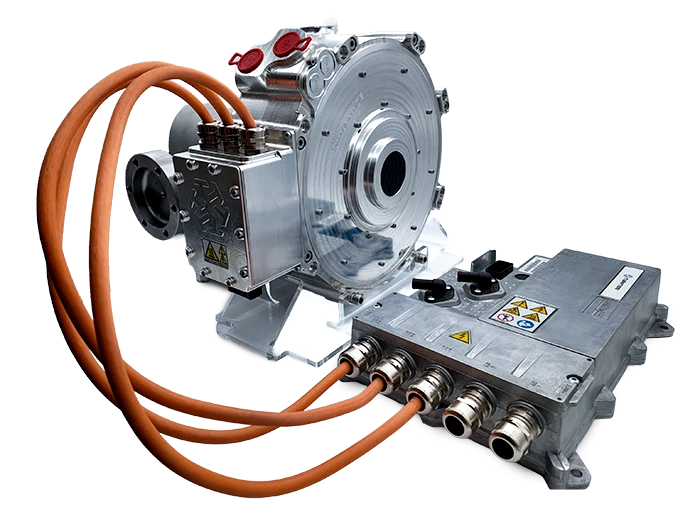
Summary: Turntide will debut its axial flux EDU, an electric power take-off system and a modular hybrid platform for commercial and off-highway vehicles during IAA Transportation 2026 in Hannover, Germany.
Key engineering takeaway: Against a radial flux equivalent, the company puts the axial flux EDU at 53% higher torque density, 58% smaller and 37% lighter, with motor, inverter and differential semi-integrated onto a shared cooling system.
Why it matters: Turntide says axial flux technology gives vehicle manufacturers a practical path to improve efficiency, reduce emissions and optimise performance, from powering the vehicle to powering the work it performs. Turntide is applying axial flux motors across propulsion, stationary auxiliary power through the ePTO System, and hybrid systems that scale from 55 kW to 1 MW.
Turntide Technologies (Turntide), a global leader in electrification and hybridization solutions, will debut its Axial Flux Electric Drive Unit (EDU), electric power take-off (ePTO), and hybrid systems during IAA Transportation 2026 in Hannover, Germany. From powering the vehicle to powering the work it performs, axial flux technology gives vehicle manufacturers a practical path to improve efficiency, reduce emissions and optimize performance.
For electrification, one size does not fit all. Manufacturers need flexible solutions that depend on the vehicle, duty cycle and job being performed. Turntide’s portfolio of compact axial flux motors delivers a combination of power density, high performance and flexibility not achievable with conventional motor designs. They support a wide range of hybrid and electric applications.
How The Axial Flux EDU Packages Motor, Inverter And Differential
The Turntide Axial Flux EDU is a modular platform with a semi-integrated motor, inverter and differential designed to scale across off-highway, commercial and construction vehicles and equipment. Compared to a radial flux EDU, the Axial Flux EDU delivers 53% higher torque density with 58% less size and 37% less weight. The EDU offers simplified gear design, a shared cooling system and independent component serviceability to reduce downtime and maintenance costs. The fully validated platform is a highly efficient, space-saving solution that decreases the risk, time and cost for OEMs to bring new products to market.
The EDU was battle-tested at the 2026 King of the Hammers, an event designed to expose drivetrain limits through sustained vibration, load, dirt, dust and heat. The EDU endured more than 600 miles of tough desert terrain.
What The ePTO Changes For Stationary Work
For applications with significant idle time, such as cement mixers, refuse trucks, cranes, lifts and booms, eliminating engine operation during stationary work reduces fuel use and engine wear. The Turntide ePTO System pairs a torque-dense axial flux motor with power electronics to deliver auxiliary power without engine idling.
Full peak torque is available from 0 rpm, providing instant controllability and allowing pump speed and flow to be optimized independently of the drivetrain. With more than 90% peak system efficiency, the scalable 50-kilowatt (kW)/100-kW/150-kW architecture works across hybrid-electric-vehicle and battery-electric-vehicle drivetrains while reducing fuel use, maintenance costs and noise.
Hybrid Systems From 55 kW To 1 MW
Across on-highway, off-highway, marine and industrial sectors, duty cycles, infrastructure limitations and cost pressures are creating demand for flexible powertrain strategies. Hybridization gives manufacturers a practical way to reduce fuel consumption and emissions while extending the life of existing vehicle and equipment platforms.
Turntide’s Hybrid Systems give OEMs a path to lower emissions while balancing efficiency, range and performance. The modular axial flux platform scales from 55 kW to 1 MW and supports series (extended range) and parallel hybrid architectures, with drop-in packaging that can simplify integration into new and existing vehicle platforms.
For more electric motor news, click here.
