

 By ATN Editorial Team
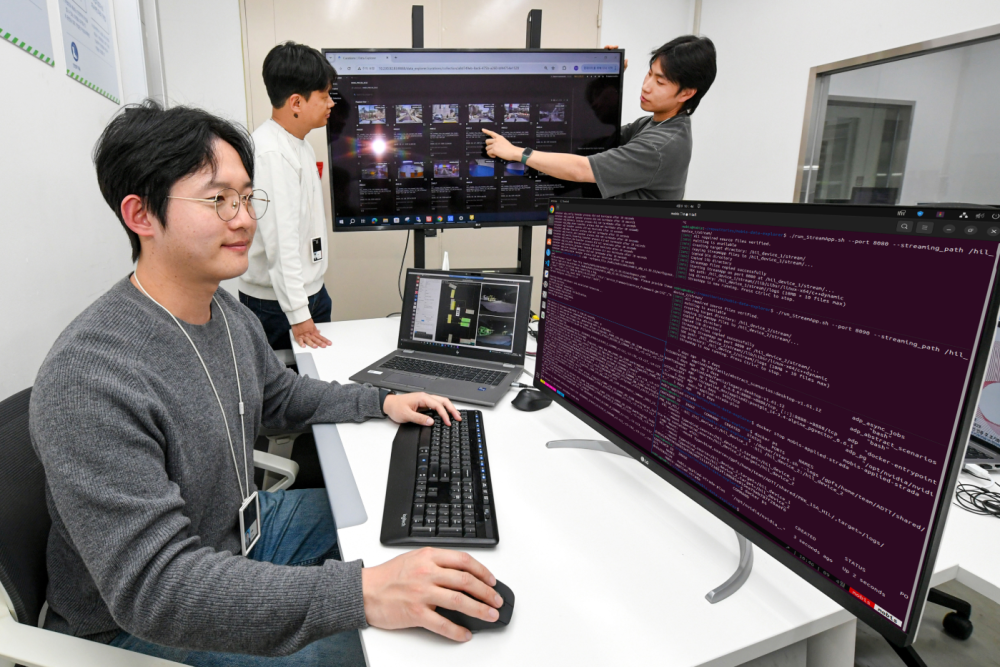
Summary: Hyundai Mobis has established an SDV validation system that links data from real-world road tests with data management solutions and multiple simulators connected in parallel, and plans to expand it to up to 60 simulators, which it says will enable 10,000 hours’ worth of ECU validation in one week.
Key engineering takeaway: The SDV validation platform is based on data collected by sensors mounted on test vehicles in real-world driving and parking environments, which it integrates with virtual simulation to replicate scenarios such as nighttime driving, rainy conditions and unexpected incidents that are difficult to reproduce in reality. The system combines real-world and virtual data in what Hyundai Mobis describes as an optimal ratio, and is designed to manage large-scale sensor data in a one-stop manner.
Why it matters: Global OEMs now require tens of thousands of hours of validated data before qualifying software-defined vehicle (SDV) components. Hyundai Mobis plans for the platform to deliver 10,000 hours of ECU validation in one week, against the years of real-world test driving such demands typically require.
As automotive software becomes more sophisticated, extensive evaluation and validation to ensure the safety and performance of related products have emerged as critical processes, alongside global R&D competition in autonomous driving and advanced driver assistance system (ADAS) technologies. In fact, Global Automakers are requiring suppliers to provide data-based validation results spanning tens of thousands of hours before adopting various core auto components for software-defined vehicles (SDVs).
Meeting such demands for tens of thousands of hours of data validation typically requires test vehicles to undergo years of test driving in real-world conditions. However, Hyundai Mobis has successfully established a data integration management solution that significantly shortens this process, enabling the company to secure a competitive edge in the global market.
How the SDV validation platform works
Hyundai Mobis announced on the 17th that it has established an evaluation and validation system capable of repeatedly testing electronic control units (ECUs) for SDVs and autonomous driving by linking data obtained from actual road tests with data management solutions and simulators to replicate various driving scenarios.
This system can drastically reduce evaluation and validation time through a platform that connects multiple simulators in parallel, reflecting various validation scenarios. Hyundai Mobis plans to expand this platform to connect up to 60 such simulators in the future. This will enable the company to perform 10,000 hours’ worth of evaluation and validation in just one week.
In particular, the system is based on data collected under various conditions in real-world driving and parking environments via sensors mounted on test vehicles. A key advantage is its ability to replicate scenarios—such as nighttime driving, rainy conditions, and unexpected incidents—that are difficult to reproduce in reality, by integrating them with simulations in a virtual environment. By combining real-world and virtual data in an optimal ratio, the company expects to comprehensively evaluate the recognition performance and stability of autonomous driving and ADAS systems.
Broader implications for SDV component qualification
Hyundai Mobis plans to actively utilise this system to comprehensively validate the performance and reliability of algorithms for autonomous driving sensors—such as radar, cameras, LiDAR, and ultrasonic sensors—as well as various ECUs. By proactively establishing this evaluation and validation system capable of managing large-scale sensor data in a one-stop manner, the company expects to strengthen its technological competitiveness for SDV advancement, thereby gaining further momentum for more aggressive global order acquisition activities.
“In the era of SDVs and autonomous driving, evaluation and validation are just as critical as technology development. We expect that establishing this evaluation and validation system will simultaneously expand the speed and scope of validation, thereby significantly boosting our competitiveness in securing orders for core SDV components,” explained Ko Bongchul, Chief of Automotive Electronics R&D at Hyundai Mobis.
Hyundai Mobis plans to continuously enhance this evaluation and validation system through data integration and collaboration with major global research hubs.
For more SDV technology news, click here.
For more SDV news, click here.
