

 By ATN Editorial Team
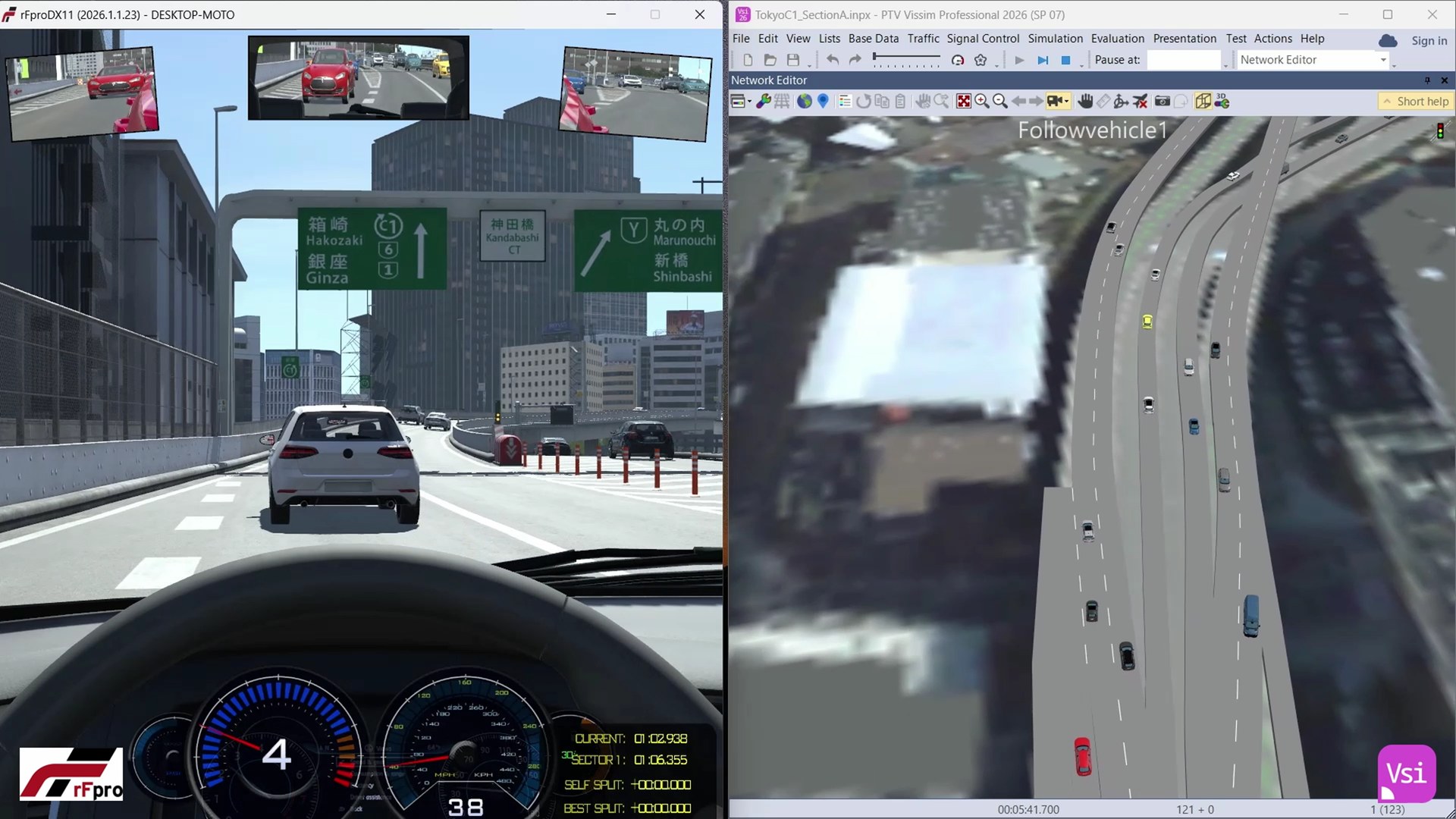
Summary: PTV Group has integrated its PTV Vissim traffic simulation software with rFpro’s driving simulation suite, so that ego vehicles simulated in rFpro and AV elevate interact in closed loop with the surrounding traffic generated by PTV Vissim. The combined environment is aimed at developing, testing and validating ADAS and autonomous driving systems in real-time Hardware-in-the-Loop (HIL) and Driver-in-the-Loop (DIL) applications, and at generating high-fidelity training data.
Key engineering takeaway: The two environments share a common road network and coordinate system, which can be established through the ASAM OpenDRIVE standard. Closed-loop interaction runs through PTV Vissim’s Driving Simulator Interface, which exchanges vehicle positions, speeds and orientations between the simulations. PTV Vissim traffic simulation models vehicles, pedestrians, cyclists, public transport and traffic control systems, while rFpro supplies the high-fidelity vehicle, sensor and environment models.
Why it matters: rFpro says PTV Vissim traffic simulation adds realistic traffic behaviours that react to the vehicles under test, so engineers can find out how an ADAS or automated driving system copes with vehicles cutting in aggressively or pedestrians stepping into the road. That testing can be done at scale, safely and repeatably, long before public road testing, and the same scenarios serve both real-time DIL/HIL simulation and training data generation.
- Seamless integration of PTV Vissim and rFpro for realistic co-simulation environments
- Closed loop interactions between high-fidelity vehicle and sensor models and large-scale traffic simulation
- Real-time DIL/HIL simulations and high-fidelity training data generated from the same scenarios
- Enhanced testing and validation of ADAS and autonomous driving systems in complex traffic scenarios
PTV Group, part of the international brand Umovity, announced the integration of PTV Vissim, its leading traffic simulation software, with rFpro, a high-fidelity driving simulation solution suite trusted by leading automotive manufacturers and motorsport organizations. By combining detailed traffic simulation with immersive vehicle-level driving simulation, the integration creates a powerful environment for developing, testing, and validating ADAS and autonomous driving technologies for both real-time Hardware-in-the-Loop (HIL) and Driver-in-the-Loop (DIL) applications as well as high-fidelity training dataset generation.
The new integration brings together the strengths of both simulation environments, enabling automotive engineers and researchers to evaluate vehicle behavior and automated driving functions in highly realistic, dynamic traffic scenarios.
rFpro Virtual Worlds And PTV Vissim Traffic Simulation
rFpro is recognized for its physically accurate virtual worlds and road surface representations that are highly immersive for human drivers as well as vehicle and sensors models, making it a preferred solution for a wide range of vehicle development and validation programs. PTV Vissim complements this with detailed, large-scale traffic simulation that realistically models interactions among vehicles, pedestrians, cyclists, public transport, and traffic control systems.
Closed Loop Co-Simulation Via OpenDRIVE And The Driving Simulator Interface
The integration enables seamless co-simulation and consistency between the two environments, including a common road network and coordinate system that can be established through the widely adopted ASAM OpenDRIVE standard. Closed loop interactions are achieved through PTV Vissim’s Driving Simulator Interface, which facilitates the exchange of vehicle positions, speeds, and orientations between the simulation environments. As a result, ego vehicles simulated in rFpro and AV elevate, powered by rFpro, can interact naturally with the surrounding traffic generated by PTV Vissim.
Urban And Highway Scenarios For ADAS Validation
This combined solution enables users to recreate realistic urban and highway scenarios in which automated vehicles must respond to complex traffic conditions, vulnerable road users, and traffic signal operations. By bringing together high-fidelity vehicle and environment simulations and easy-to-define, realistic traffic behaviors, the fully integrated simulation solution provides a comprehensive ecosystem for testing and validating ADAS and autonomous driving systems under real-world conditions.
“rFpro gives engineers highly accurate virtual environments in which to test, and PTV Vissim now adds realistic traffic behaviours that react to the vehicles under test,” says Matt Daley, Technical Director at rFpro. “Our AV elevate simulation solution expands possibilities, enabling engineers to find out how an ADAS or automated driving system copes with real-world behaviours, such as vehicles cutting in aggressively or pedestrians stepping out into the road. This can all be done at great scale, safely and repeatably, long before testing occurs on public roads.”
“The combination of PTV Vissim’s realistic traffic simulation and rFpro’s high-fidelity driving environment creates a powerful platform for automotive innovation,” says Hilary Aylesworth, Chief Product and Technology Officer at PTV Group, Umovity’s Software Business. “As the industry accelerates the development of connected, automated, and autonomous vehicles, engineers need testing environments that accurately reflect the complexity of real-world traffic. Together, we are helping make that possible.”
PTV Vissim Traffic Simulation: Frequently Asked Questions
What does the PTV Vissim and rFpro integration do?
It connects PTV Vissim traffic simulation with rFpro’s driving simulation suite so that ego vehicles simulated in rFpro and AV elevate interact in closed loop with surrounding traffic generated by PTV Vissim. PTV Group says it is intended for developing, testing and validating ADAS and autonomous driving systems in real-time HIL and DIL applications, and for generating high-fidelity training datasets.
How does PTV Vissim exchange data with rFpro?
Closed-loop interaction runs through PTV Vissim’s Driving Simulator Interface, which exchanges vehicle positions, speeds and orientations between the two simulation environments. A common road network and coordinate system can be established through the ASAM OpenDRIVE standard.
What is ASAM OpenDRIVE?
ASAM OpenDRIVE is a standard file format for describing road networks for simulation, covering road geometry, lanes, junctions and road furniture such as signals. Using it lets different simulation tools work from the same description of the road, which keeps their coordinate systems consistent.
What is the difference between HIL and DIL simulation?
Hardware-in-the-Loop (HIL) simulation connects real control hardware, such as an ECU or sensor, to a simulated vehicle and environment that runs in real time. Driver-in-the-Loop (DIL) simulation puts a human driver in a simulator so their responses form part of the test. Both need the simulation to run in real time.
What is closed-loop co-simulation?
Co-simulation runs two or more simulation tools together, each handling part of the problem. In closed loop, each tool responds to the other’s outputs at every step, so in this case the traffic reacts to what the vehicle under test does and the vehicle reacts to the traffic, rather than following a pre-scripted sequence.
Further Reading
- Driver Monitoring Simulation Tool Targets Euro NCAP 2026 Tests
- rFpro Integrates Solectrix SXIVE ISP For Camera Simulation
- What Is A DIL Simulator? A Driver-in-the-Loop Engineer’s Guide
- VI-grade And Aidoptation Partner On Autonomous Driving Validation
For more simulation news, click here.
