

 By ATN Editorial Team
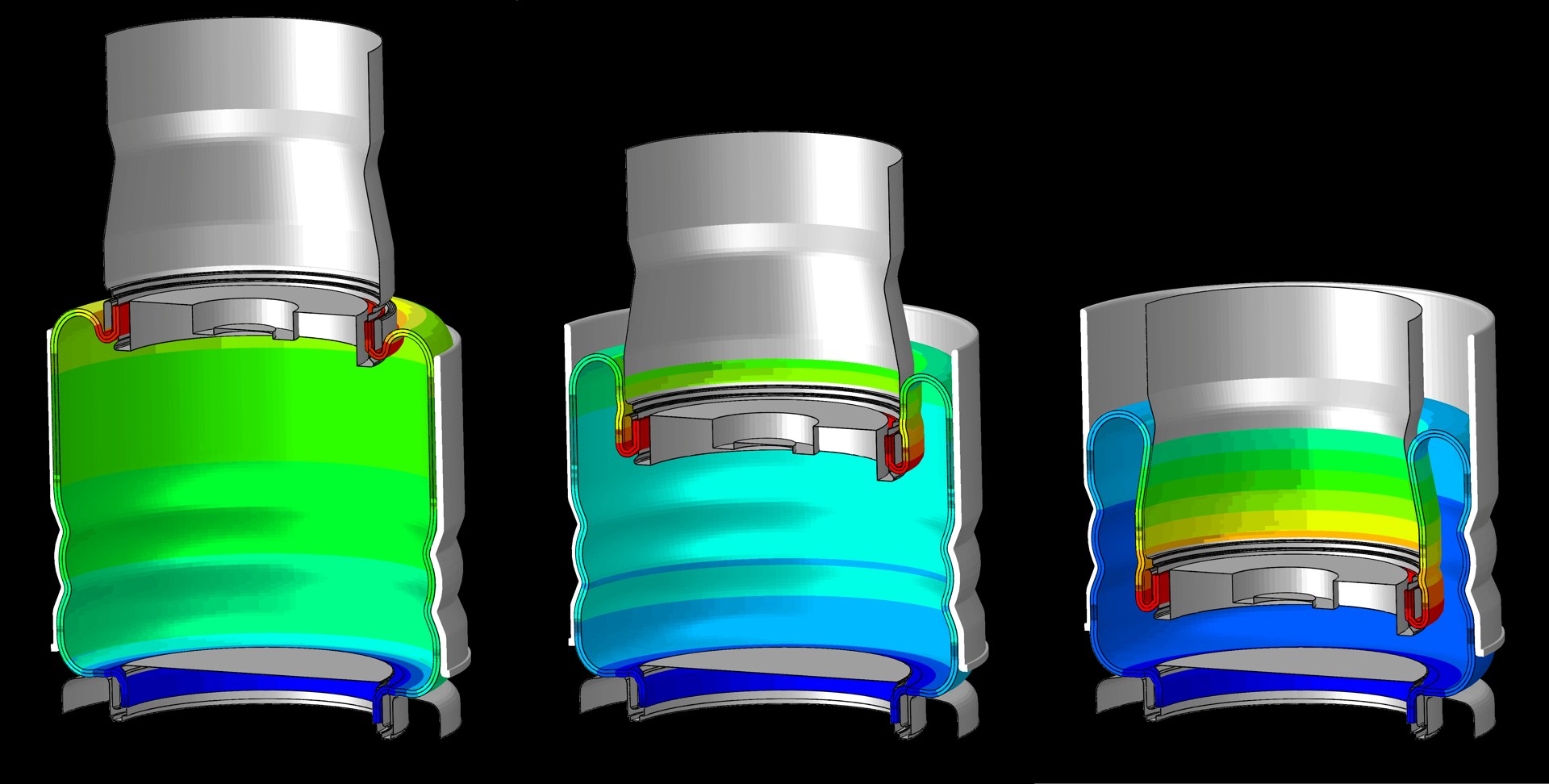
Summary: BWI Group has disclosed details of an in-house AI suspension development tool that reduces suspension development time from weeks to approximately one hour. Developed at the company’s Technical Centre Kraków (TCK), the deep-learning system has been validated on an air spring development project and is now being extended to other suspension architectures.
Key engineering takeaway: The AI suspension development tool is a five-layer deep neural network trained on 180 finite element analysis (FEA) datasets, generated by simulation models validated against laboratory testing, and acts as a fast-evaluating surrogate for conventional simulation. BWI Group reports an R² value of 99% against the FEA results. On the air spring project, a Newton-based optimisation algorithm searched five parameters (piston radius, low support radius, sleeve thickness, design pressure and nylon fibre cord angles) and converged to a residual error of approximately 2% relative to the OEM’s target force-displacement curve.
Why it matters: According to BWI Group, matching an OEM’s target force-displacement curve for an air spring typically takes several weeks of FEA-supported design iterations. Using the AI suspension development tool, the company found the target could be met without a structural constraint component the engineering team had concluded was necessary. BWI Group describes this as a technical proof of feasibility rather than a validated production design, and says eliminating the component would reduce mass and material usage, simplify assembly and remove the associated tooling.
- In-house deep-learning tool developed at BWI Group replaces weeks of iterative FEA simulation with a one-hour optimisation process, first validated on an air spring development project
- The tool uncovered viable suspension designs that experienced engineers had considered unachievable, demonstrating AI’s potential to expand the boundaries of chassis development
- Validated against physical test data with 99% correlation, the approach is already being extended to other suspension architectures as the chassis industry accelerates AI adoption
BWI Group, a leader in advanced suspension and braking systems, has disclosed details of a bespoke artificial intelligence (AI) tool that reduces suspension development time from weeks to approximately one hour. Developed in-house at the company’s Technical Centre Kraków (TCK), the deep-learning system has been validated on an air spring development project and is now being extended to other suspension architectures.
Suspension development is among the most parameter-intensive challenges in chassis engineering. For air springs, the force-displacement performance characteristics demanded by an OEM are governed by the complex, non-linear interaction of geometry, internal pressure, material behaviour and reinforcement architecture. Matching a target performance curve typically requires repeated design iterations supported by finite element analysis (FEA), with each loop demanding new simulations, interpretation of results and informed design changes. Even for experienced teams, convergence routinely takes several weeks.
How The AI Suspension Development Tool Works
The methodology developed at TCK replaces this iterative process with a five-layer deep neural network trained on 180 high-quality FEA datasets. These datasets were generated using simulation models validated against extensive laboratory testing, meaning the AI learns from physically verified engineering data rather than theoretical approximations. The neural network acts as a fast-evaluating surrogate for conventional simulation, mapping the relationship between key design parameters and resulting suspension performance.
This deep learning-based surrogate model is able to accurately predict the system’s behaviour, achieving an R² value of 99% compared to the FEA results,” said Miroslaw Siemieniuk, FEA Manager at BWI Group. “Every dataset the AI learns from has been generated by validated simulation models that correlate with physical test results. Without that foundation, the outputs would be meaningless. What the AI gives us, once learned, is speed. The ability to explore a design space in minutes that would otherwise take weeks.”
In the initial air spring project, the model optimised five critical parameters: piston radius, low support radius, sleeve thickness, design pressure and nylon fibre cord angles. A Newton-based optimisation algorithm searched for the combination that minimised the error between the predicted force-displacement curve and the OEM’s target. The optimisation process effectively converges, reaching a residual error of approximately 2% relative to the target curve.
Air Spring Target Met Without A Structural Constraint Component
Perhaps the most significant outcome emerged when the AI explored areas of the design space that engineers had previously discounted. During manual development, the team had concluded that the OEM’s target performance curve could not be achieved without a specific structural constraint component. The AI tool, unconstrained by prior assumptions and able to evaluate the full parameter space rapidly, indicated that the target could in fact be met without it.
The finding represents a technical proof of feasibility rather than a validated production design. Nonetheless, the implications for OEMs could be considerable. Eliminating the component would reduce mass and material usage, simplify assembly and remove the associated tooling.
“This is not about replacing engineers,” continued Siemieniuk. “The quality of the training data, the assumptions in the simulation models, the selection of physically meaningful parameters, all of that requires deep engineering knowledge. What AI does is shift the engineer’s focus away from repetitive calculation and towards system-level understanding, judgement and innovation.”
Extending The Approach To Other Suspension Architectures
The approach reflects a broader shift taking hold across the automotive industry. As OEM development timelines compress and vehicle architectures grow heavier and more complex, chassis suppliers are under increasing pressure to deliver precise performance targets faster. AI-augmented engineering tools offer a route to meeting that demand, provided they are built on rigorous physical foundations.
The AI framework developed at TCK has been designed with scalability in mind. While the initial project assessed five critical parameters, this is being expanded to cover aspects such as sleeve height, piston geometry and air spring volume. BWI Group is already working to extend the same methodology to other suspension architectures, including passive valve systems.
“This first project is a clear proof of concept, but the ambition goes well beyond a single component,” added Siemieniuk. “We are building a platform that will allow us to bring AI-driven optimisation to multiple areas of chassis development. The engineering fundamentals come first and the AI amplifies what our teams can achieve with them.”
AI Suspension Development Tool: Frequently Asked Questions
What is BWI Group’s AI suspension development tool?
It is an in-house deep-learning system developed at BWI Group’s Technical Centre Kraków (TCK) that reduces suspension development time from weeks to approximately one hour. It has been validated on an air spring development project and is being extended to other suspension architectures, including passive valve systems.
How accurate is the AI suspension development tool?
BWI Group reports an R² value of 99% for the neural network’s predictions compared with FEA results. On the air spring project, the optimisation converged to a residual error of approximately 2% relative to the OEM’s target force-displacement curve.
What is a surrogate model in simulation?
A surrogate model is a fast approximation of a slower, more detailed simulation. It is trained on results from the full model, here FEA, and learns the relationship between design inputs and outputs, so that many design variants can be evaluated in a fraction of the time a full simulation run would take. Its predictions are only as good as the data it was trained on.
Which air spring parameters did the AI suspension development tool optimise?
In the initial project, the tool optimised five parameters: piston radius, low support radius, sleeve thickness, design pressure and nylon fibre cord angles. BWI Group is expanding this to cover aspects such as sleeve height, piston geometry and air spring volume.
What is a force-displacement curve for an air spring?
A force-displacement curve describes how much force an air spring produces at each point in its compression and extension stroke. An OEM specifies a target curve to define the spring’s behaviour, and the supplier’s task is to find a design whose curve matches it as closely as possible.
Further Reading
- Compressing Development From Weeks To An Hour With AI
- BWI Group Develops Automated Semi Active Roll Control System
- BWI Group Launches Integrated Dynamic Brake Control System
- Vibracoustic Engineers EV-Specific Air Springs
For more suspension news, click here.
