

 By ATN Editorial Team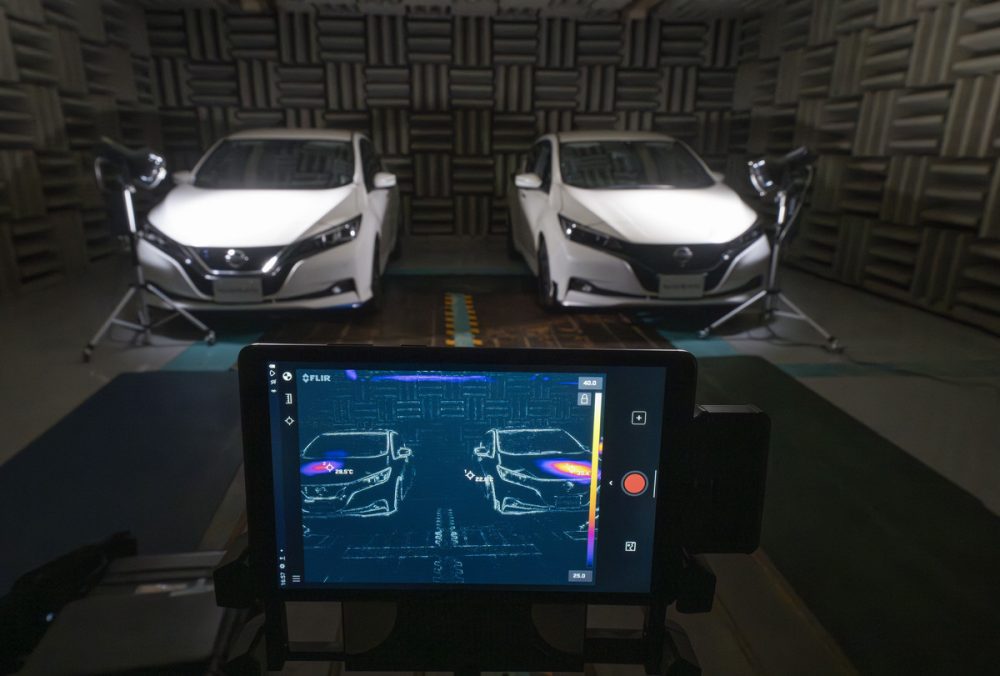
Nissan cool paint technology with embedded metamaterial can lower cabin temperatures and reduce energy usage, taking the heat out of summer
The paint’s cooling performance is particularly noticeable when a vehicle is parked in the sun for an extended period. A cooler cabin is not only more pleasant to enter, but also requires less air-conditioning run-time to cool the cabin to a comfortable temperature. This helps reduce load to the engine, or in the case of an electric vehicle, draw on the battery. In both powertrains, an improvement in efficiency is expected, as well as occupant comfort.
The metamaterial embedded within Nissan’s cool paint features two microstructure particles that react to light. One particle reflects near-infrared rays in the sunlight that would typically cause molecular level vibrations within the resin of traditional paint to produce heat.
The second particle enables the real breakthrough. It creates electromagnetic waves, that counteract the sun’s rays, redirecting the energy away from the vehicle into the atmosphere. Combined, the particles in Nissan’s cool paint reduce the transfer of heat into surfaces such as the roof, hood, doors and panels.
Leading the development is Dr. Susumu Miura, senior manager and expert at the Advanced Materials and Processing Laboratory, Nissan Research Center. He played a leading role in Nissan’s award-winning noise-reducing acoustic material, and has dedicated much of his career at Nissan to exploring ways to make cars quieter, cooler and more efficient.
“My dream is to create cooler cars without consuming energy” explained Miura. “This is especially important in the EV era, where the load from running air-conditioning in summer can have a sizable impact on the state of charge,” he said.
While radiant cooling paint isn’t new, it is typically used for buildings and structures. It’s often very thick, requiring application by a paint roller. Devoid of any clear topcoat, it can leave a chalky residue when touched.
Key challenges Miura had to consider when developing an automotive version, was to ensure it could incorporate a clear topcoat, be applied via a spray gun (not a roller), and meet Nissan’s rigorous internal standards for paint quality.
Since commencing the development in 2021, Miura and his team have tested over 100 samples, and are currently evaluating a thickness of 120 microns, approximately six times thicker than typical automotive paint. They have confirmed resistance to salt and chipping, peeling, scratches, chemical reactions, along with color consistency and repairability. As development progresses, Miura and his team continue to explore thinner options that deliver the same level of cooling performance.
While the testing and development is ongoing, for Miura and his team, the hope is that it can one day be offered for special orders and in a variety of colors.
Miura sees strong potential, particularly for light commercial vehicle applications such as vans, trucks and ambulances that spend most of the day out driving.
For more thermal management technology news, click here.
