

 By ATN Editorial Team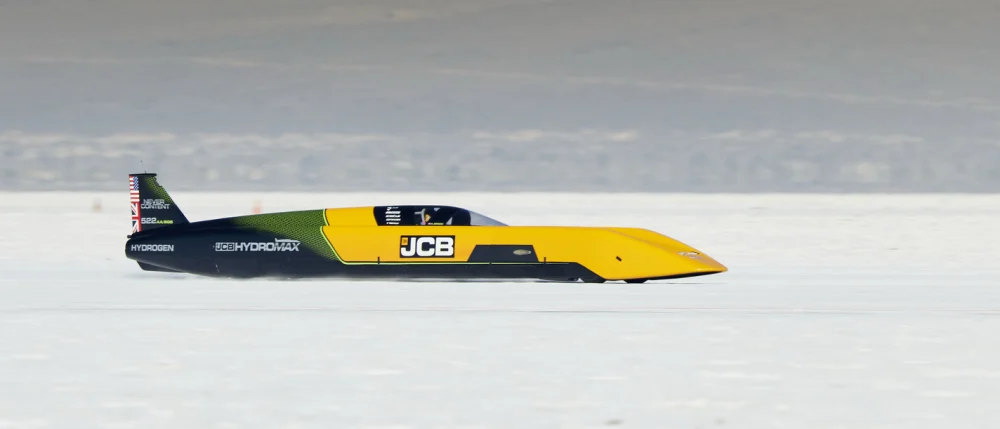
Summary: The FIA has confirmed a new World Land Speed Record for a hydrogen-powered vehicle of 406.320 mph, set by the JCB Hydromax at the Bonneville Salt Flats on 11 August 2026 with Andy Green driving. The twin-engine streamliner runs two hydrogen internal combustion engines derived from JCB’s production construction-machinery units, producing a combined 1,600 bhp.
Key engineering takeaway: The engines were built at JCB’s Foston plant in Derbyshire on the same base architecture as its construction-machinery hydrogen units, then uprated substantially for the attempt with Ricardo supporting the development work. Green recorded 400.623 mph on the first run and 412.135 mph on the second for the 406.320 mph two-way average.
Why it matters: Hydrogen combustion retains the thermal-management, lubrication and durability characteristics of a conventional engine, which makes it a nearer-term route for off-highway and heavy-duty applications than a fuel-cell conversion. This land speed record more than doubles the previous FIA hydrogen internal combustion benchmark of 185.5 mph and exceeds the 303 mph mark held by fuel-cell vehicles.
Auto Tech View:
- The record more than doubles the previous FIA hydrogen internal combustion benchmark of 185.5 mph, set by the BMW H2R in 2004.
- It also exceeds the 303 mph mark held by hydrogen fuel-cell vehicles, making Hydromax the fastest hydrogen-powered vehicle of any kind.
- The significance for engineers is the engine provenance: these are production-based units from a construction-equipment programme, not bespoke racing hardware.
Andy Green recorded an average of 400.623 mph on the first run of the day and 412.135 mph on the second, giving a two-way average of 406.320 mph. The Federation Internationale de l’Automobile has since confirmed the figure as a World Land Speed Record for a hydrogen-powered vehicle.
Production Engine Lineage, Not Bespoke Racing Hardware
The engineering interest in Hydromax sits less in the speed than in what is producing it. The 32-foot streamliner carries two hydrogen internal combustion engines built at JCB’s engine plant in Foston, Derbyshire, the same facility and the same base architecture behind the hydrogen units JCB has been developing for construction machinery. Combined output is 1,600 bhp.
As Auto Tech News reported in June, the record programme took JCB’s production hydrogen engine and uprated it substantially for the attempt, with Ricardo supporting the development work. The engines burn hydrogen in a modified internal combustion cycle rather than converting it electrochemically, so the powertrain produces mechanical power directly and emits water vapour rather than CO2 at the tailpipe.
That distinction matters for the sectors watching this closely. Hydrogen combustion retains the thermal-management, lubrication and durability characteristics of a conventional engine, which makes it a nearer-term proposition for off-highway and heavy-duty applications than a fuel-cell conversion. A record run is not a duty cycle, but it is a public demonstration that the combustion route can be pushed a long way beyond its previous ceiling.
How The Record Fits Andy Green’s Record History
Green already held the diesel land speed record, set at Bonneville in 2006, and remains the only driver to have broken the sound barrier in a car, at 763 mph in the jet-powered ThrustSSC in 1997. The Hydromax run adds a third fuel category to that list.
The 406.320 mph figure supersedes the 368.347 mph SCTA US national record the car set earlier in the same Bonneville week, which Auto Tech News covered on 11 August.
Hydrogen Land Speed Record: Frequently Asked Questions
What is the hydrogen land speed record?
The FIA World Land Speed Record for a hydrogen-powered vehicle is 406.320 mph, set by the JCB Hydromax at the Bonneville Salt Flats on 11 August 2026 with Andy Green driving. It is the fastest speed achieved by any hydrogen-powered vehicle, combustion or fuel cell.
How fast is the JCB Hydromax?
Hydromax averaged 406.320 mph across two runs, recording 400.623 mph on the first and 412.135 mph on the second. Its peak recorded run speed was therefore 412.135 mph.
What engines does the JCB Hydromax use?
Two hydrogen internal combustion engines producing a combined 1,600 bhp, derived from JCB’s production construction-machinery hydrogen engine and built at the company’s Foston plant in Derbyshire.
What record did the JCB Hydromax beat?
The previous FIA hydrogen internal combustion record was 185.5 mph, set by the BMW H2R in 2004. Hydromax more than doubled it, and also exceeded the 303 mph mark previously held by hydrogen fuel-cell vehicles.
Is hydrogen combustion the same as a hydrogen fuel cell?
No. A hydrogen internal combustion engine burns hydrogen in a modified conventional engine to produce mechanical power directly. A fuel cell converts hydrogen to electricity to drive an electric motor. Hydromax uses combustion.
Further Reading
- JCB Hydromax Sets US Hydrogen Land Speed Record At Bonneville
- JCB Hydromax Begins Hydrogen Land Speed Record Testing
For more hydrogen news, click here.
