

 By ATN Editorial Team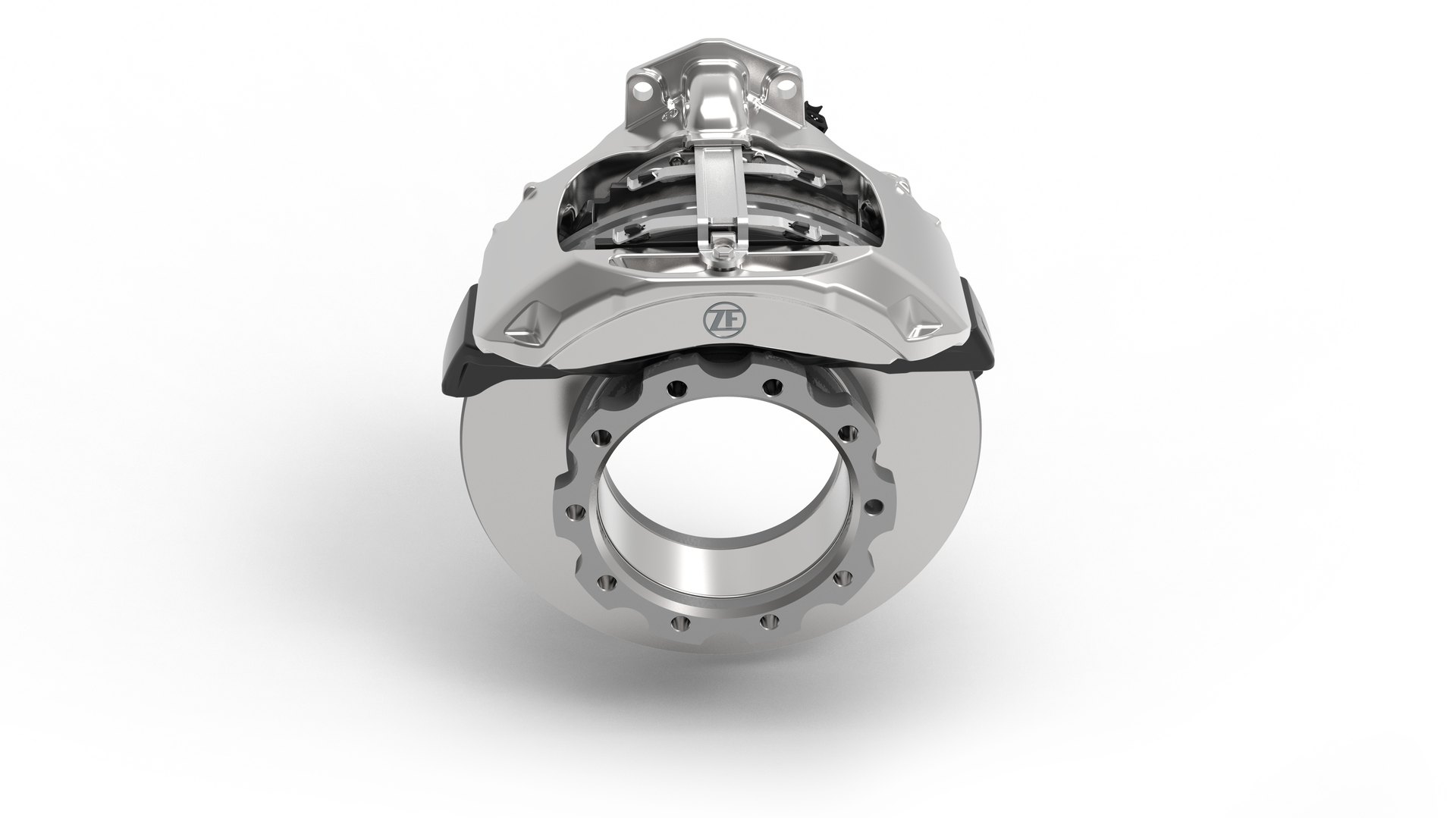
Summary: ZF has given the world premiere of MAXX Uniper, its next-generation air disc brake for heavy-duty commercial vehicles, at IAA Transportation 2026. The MAXX Uniper air disc brake is aimed squarely at the brake-particle limits arriving with EURO 7, and start of production is expected in 2027.
Key engineering takeaway: ZF states that a specially coated rotor cuts PM10 brake-particle emissions by up to 65%. The brake delivers brake torque of up to 30,000 Nm and is built on ZF’s single-piston brake technology, with a proven bi-directional adjuster that regulates the running clearance between pad and rotor to support even pad wear and reduce the risk of overadjustment. A new carrier and brake pad system enables convenient brake pad replacement, and an exchangeable, calibration-free continuous wear sensor is available as an option.
Why it matters: ZF says MAXX Uniper is designed to support vehicle manufacturers in addressing upcoming EURO 7 brake-particle reduction requirements, while delivering brake torque of up to 30,000 Nm. ZF says the modular architecture allows vehicle manufacturers to apply one air disc brake concept across global heavy-duty commercial vehicle platforms and applications, helping reduce application and release efforts.
- World premiere at IAA Transportation 2026: designed to be EURO 7-compliant air disc brake with specially coated rotor that reduces PM10 emissions by up to 65%
- Brake performance of up to 30,000 Nm for demanding heavy-duty commercial vehicles
- Compact, modular single-piston design supports reliability, easier servicing and integration across global vehicle platforms
At IAA Transportation 2026, ZF is presenting the world premiere of MAXX Uniper, its next-generation air disc brake for heavy-duty commercial vehicles. Built on ZF’s pioneering single-piston brake technology, MAXX Uniper is designed to meet today’s performance and operational needs while supporting vehicle manufacturers in addressing upcoming EURO 7 brake-particle reduction requirements. In combination with a specially coated rotor reduces brake-particle emissions by up to 65 percent, while the brake delivers consistently high performance even under demanding operating conditions.
Building on more than 30 years of ZF’s pioneering work in single-piston air disc brake technology and 12 million units sold, MAXX Uniper represents the next generation of ZF’s MAXX air disc brake platform. It delivers brake torque of up to 30,000 Nm. Its proven bi-directional adjuster, thoroughly tested and validated under demanding environmental conditions, regulates the running clearance between the brake pad and rotor, supporting even pad wear and reducing the risk of overadjustment.
A Compact, Modular Brake For The EURO 7 Era
Its compact design uses fewer parts to support high reliability and easier servicing, while a new carrier and brake pad system enables convenient brake pad replacement. The modular architecture allows vehicle manufacturers to apply one air disc brake concept across global heavy-duty commercial vehicle platforms and applications, helping reduce application and release efforts. Start of production is expected in 2027.
“MAXX Uniper brings together what the commercial vehicle industry needs for the EURO 7 era: reduced brake-dust emissions, powerful braking performance and proven reliability,” said Pawel Porczynski, Head of Business Unit Chassis Solutions, CVS Division. “It demonstrates how ZF is translating evolving regulatory requirements into practical technology that creates value for vehicle manufacturers and fleets.”
Wear Sensing And Fleet Uptime
Fleet operators benefit from convenient brake pad replacement and the option of a plug-and-play continuous wear sensor. The exchangeable, calibration-free sensor helps reduce maintenance effort and increase vehicle uptime, while robust sealing protects the brake against dirt and debris in demanding operating environments.
The MAXX Uniper Air Disc Brake In ZF’s Axle Systems
As part of ZF’s broader technology portfolio supporting vehicle manufacturers in meeting EURO 7 requirements, MAXX Uniper also strengthens ZF’s ability to provide integrated axle systems for conventional, hybrid and fully electric commercial vehicles. By combining ZF’s low brake dust particle emission technology with efficient and electrified chassis, driveline and further solutions, manufacturers can help lower the environmental impact of road transportation.
ZF is showcasing MAXX Uniper alongside its latest technologies for safer, cleaner and smarter commercial vehicles at IAA Transportation 2026 in Hanover. Visitors and media representatives can experience ZF’s technology portfolio in Hall 21, Booth B42, through September 20, 2026.
Frequently Asked Questions
What is the ZF MAXX Uniper air disc brake?
MAXX Uniper is a single-piston air disc brake for heavy-duty commercial vehicles, the next generation of ZF’s MAXX platform. It combines a specially coated rotor intended to cut brake-particle emissions with brake torque of up to 30,000 Nm, a bi-directional adjuster and an optional continuous wear sensor. Start of production is expected in 2027.
Why does EURO 7 regulate brake dust?
Brake wear is a non-exhaust emission: friction between pad and rotor abrades both surfaces and releases particles directly into the air. As tailpipe emissions have fallen, non-exhaust sources have become a proportionally larger share of traffic-related particulate matter, and they do not disappear when a vehicle is electrified. EURO 7 is the first European framework to set limits on brake particulate emissions rather than only on what leaves the exhaust.
How does a coated brake rotor reduce particulate emissions?
A coating applies a harder, denser layer to the rotor’s friction surface, typically a carbide or similar hard-facing applied by thermal spray or laser cladding. The harder surface resists abrasion, so less material is lost from the rotor as wear debris, and it also changes the way the friction pair behaves so the pad sheds less. The trade-off is cost and the need to match the pad compound to the coated surface, since a coating optimised in isolation can simply move the wear into the pad.
What is PM10 in a brake emissions specification?
PM10 is particulate matter with an aerodynamic diameter of 10 micrometres or less, the fraction small enough to be drawn into the airways. It is the measure regulators have historically used for coarse airborne particulate. Brake wear produces particles across a range of sizes, and PM10 is the fraction ZF quotes for the up to 65% reduction delivered by the MAXX Uniper coated rotor.
What does a bi-directional adjuster do in an air disc brake?
The adjuster maintains the running clearance, the small gap between pad and rotor when the brake is released. Too large a gap lengthens pedal response and stroke; too small a gap causes drag, heat and premature wear. A bi-directional adjuster can take up clearance as the pad wears and give it back, which guards against overadjustment, the condition where the mechanism winds the pad progressively closer to the rotor and causes it to bind.
For more braking news, click here.
