

 By ATN Editorial Team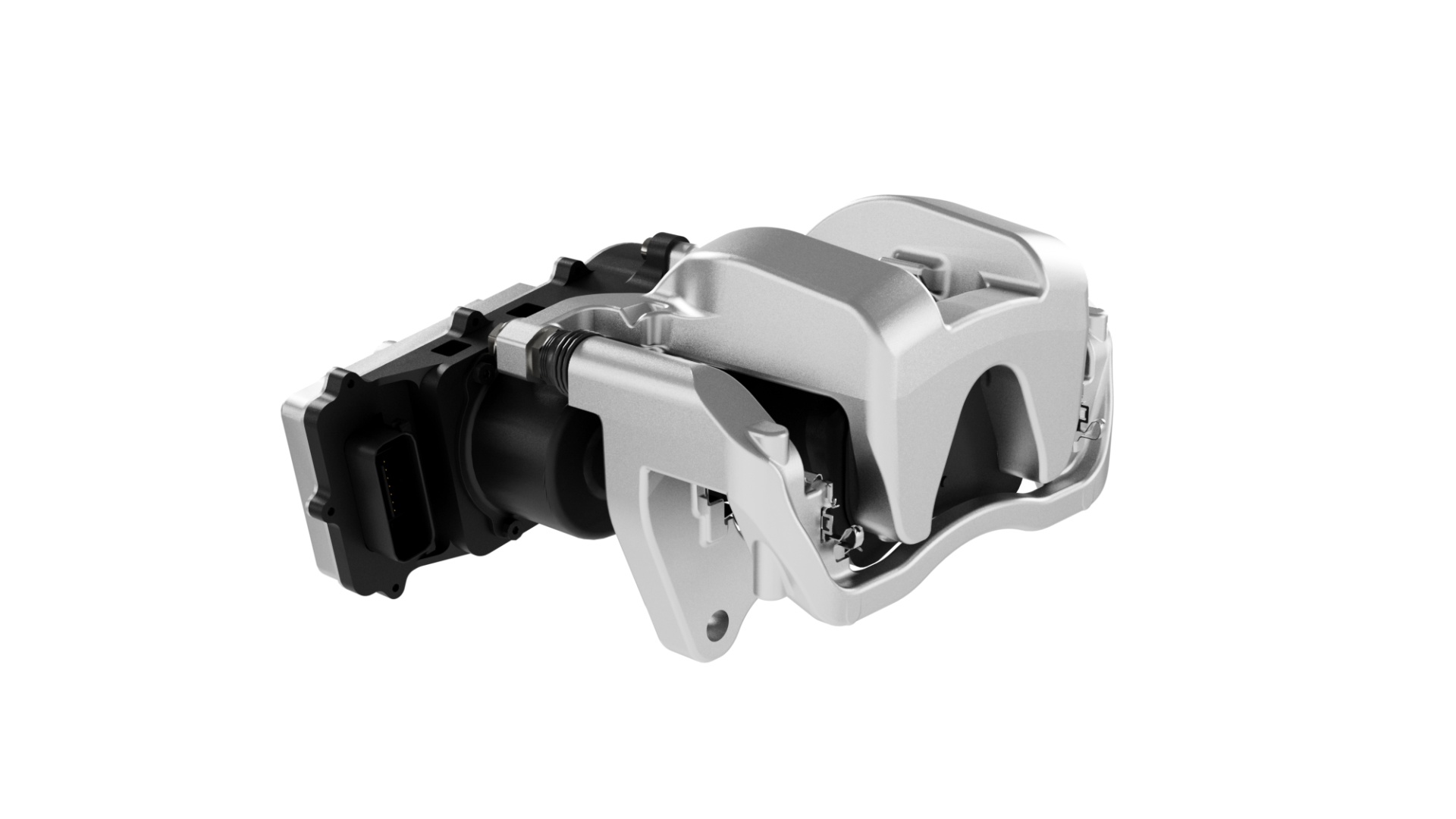
Summary: AUMOVIO has fitted Volkswagen’s “Mission Efficiency” demonstrator with a semi-dry brake system, combining hydraulic and electromechanical braking on the same car. The current MK C2 one box system and optimised calipers handle the front axle, while a near-production electromechanical brake takes the rear.
Key engineering takeaway: Both axles run a larger air gap than the series ID. Polo, and a wider gap between disc and pad reduces unwanted friction and residual braking torque. The semi-dry brake system goes further on the rear: faster electromechanical actuation allows an even larger air gap, and the electric motor can reopen the caliper deliberately and hold the gap constant, so there is no memory effect after the parking brake is applied or after heavy braking. Volkswagen records 7.51 kWh/100 km including charging losses and 6.89 kWh/100 km excluding them, against 6.48 kWh/100 km on an ideal drive.
Why it matters: The semi-dry brake system tailors hydraulic and electromechanical brake technologies to the requirements of electric vehicles, reducing residual braking torque on both axles, and AUMOVIO says the braking system can contribute to energy efficiency in many different ways. The company adds that the driving dynamics benefits, including regenerative braking performance and vehicle stability, could be amplified further in a fully dry system with electromechanical calipers on all four wheels. Volkswagen’s “Mission Efficiency”, which AUMOVIO calls the world’s most efficient near-production electric car, set three world records during the study.
- Collaboration with Volkswagen: The braking system for the “Mission Efficiency” concept car, based on the ID. Polo, combines hydraulic and electromechanical brake technologies
- One box system MK C2 and adapted brake calipers on the front and rear axle optimize regenerative braking and reduce residual braking torque
- Boris Mergell, Head of the Safety and Motion business area at AUMOVIO: “The ‘Mission Efficiency’ demonstrates that the journey toward greater energy efficiency in electric vehicles is far from over”
Technology company AUMOVIO has equipped Volkswagen’s “Mission Efficiency”, the world’s most efficient near-production electric car, with a new semi-dry brake system. It combines the latest hydraulic and electromechanical brake technologies to tailor the brakes specifically to the requirements of electric vehicles: On the front axle, the current generation of the one box system MK C2, which is optimized for regenerative braking, is used together with optimized hydraulic brake calipers. AUMOVIO equips the rear axle with a near-production electromechanical brake (EMB). Compared with the production vehicle, the air gap – the distance between the brake disc and brake pad – is larger on both axles. This further reduces unwanted friction in the wheel brakes.
Especially with electric vehicles, energy efficiency is one of the key drivers of development for greater range and lower energy consumption. The braking system can contribute in many different ways as well. To this end, we draw on our 120 years of experience in development. Volkswagen’s ‘Mission Efficiency’ demonstrates that the journey toward greater energy efficiency in electric vehicles is far from over.
Boris Mergell, Head of the Safety and Motion business area at AUMOVIO
How The MK C2 Front Axle Supports Regenerative Braking
With the MK C2 and the front axle calipers, AUMOVIO already supplies a braking system for the in-series ID. Polo that is designed entirely to support regenerative braking. As a so-called brake-by-wire solution, it transmits the braking command electronically and is therefore completely decoupled from the hydraulic system. Unlike electric brake boosters, which are still connected to the hydraulic system, this allows for regenerative braking without friction losses.
To ensure that as little kinetic energy as possible is “wasted”, the system decides on its own whether to engage the friction brake or whether the braking command should be used to recover energy via the electric generator. In the “Mission Efficiency” project vehicle, AUMOVIO has also optimized the hydraulic front axle caliper. Compared to the series model, this caliper can build up a larger air gap more quickly, thereby minimizing residual braking torque.
Electromechanical Brakes And A Constant Air Gap On The Rear Axle
A new feature compared to the standard braking system on the ID. Polo are the electromechanical brakes on the rear axle. Instead of hydraulic pressure (“wet” brakes), the brake calipers are actuated by an electric motor (“dry” brakes) and therefore do not require hydraulic lines or brake fluid. Thanks to the faster electromechanical actuation, the air gap can be increased even further compared to the brake calipers on the front axle. This further reduces residual braking torque. Another advantage of the electromechanical solution is that the air gap can be actively adjusted via the electric motor, ensuring it remains constant. After the electric parking brake is applied or high braking forces are applied, the caliper is deliberately reopened, regardless of the previous application. Unlike with hydraulic brakes, there is therefore no memory effect, with an initially increased residual braking torque that would consume energy, even after heavy braking maneuvers.
Vehicle Dynamics And Regenerative Braking Potential
Irrespective of the study’s focus, the semi-dry brake system offers further potential to make electric vehicles even more efficient and improve their performance. This primarily concerns driving dynamics because the EMB can distribute brake forces dynamically and individually to each wheel. This further improves regenerative braking performance, increases vehicle stability, especially when cornering, and enhances braking comfort. This effect can be further amplified in a fully dry system with electromechanical calipers on all four wheels.
To ensure situation-appropriate braking, the EMB can also intelligently adjust the air gap: When cornering, it increases the air gap to reduce residual braking torque; when hazardous situations are detected early, it reduces the distance between the brake pad and disc to bring the vehicle to a stop even more quickly.
Since the semi-dry system for the rear wheel brakes requires neither hydraulic lines nor brake fluid, weight can be reduced depending on the model; in addition, brake maintenance requirements are lowered. At the same time, design flexibility in vehicle architecture increases.
Smart Sizing Brake Calipers For Electric Vehicles
One example of an optimized hydraulic application is the “smart sizing” concept for brake calipers. To this end, AUMOVIO has specifically refined the brake design to meet the requirements of electric vehicles, streamlining and reducing the number of components. A smaller housing and an adjusted pad mass reduce the weight of the caliper. The concept also allows for a greater air gap, thereby reducing the residual braking torque. Since the brake engages further outward on a larger, thinner disc, less clamping force is required to achieve the same braking torque.
Volkswagen Mission Efficiency Energy Consumption Records
As part of the “Mission Efficiency” study, Volkswagen has unveiled the world’s most efficient electric car. With the help of new technologies (e.g. a solar roof) and adaptations to mass-production technology such as the MK C2, it recently set three world records that demonstrate its energy efficiency. First: It is more aerodynamic than any other car ever approved for road use. Second: During a so-called ideal drive (i.e. without inclines or auxiliary consumers), it achieved a record-breaking energy consumption of just 6.48 kWh/100 km. Third: Thanks to its aerodynamics and a highly efficient electric powertrain, the “Mission Efficiency” is also the most fuel-efficient near-production electric car. During a fuel-efficiency test drive from the Volkswagen Development Center in Wolfsburg, Germany, via Poznań (Poland) and Olomouc (Czech Republic) to the Austrian capital of Vienna, the “Mission Efficiency” electric motor achieved an actual energy consumption of just 7.51 kWh/100 km, including charging losses (6.89 kWh/100 km excluding charging losses).
Further information on “Mission Efficiency” is available in Volkswagen’s press release.
Semi-Dry Brake System FAQ
What is a semi-dry brake system?
A semi-dry brake system is a mixed brake architecture that uses hydraulic friction brakes on one axle and electromechanical, fluid-free brakes on the other. On Volkswagen’s Mission Efficiency the front axle keeps AUMOVIO’s MK C2 one box hydraulic system with optimised calipers, while the rear axle runs a near-production electromechanical brake actuated by an electric motor. It sits between a conventional wet system and a fully dry system with electromechanical calipers at all four wheels.
How does a semi-dry brake system reduce energy consumption?
It widens the air gap, the clearance between the brake disc and the pad, on both axles. A wider gap means less unintended contact between pad and disc when the brake is not being applied, which cuts residual braking torque and therefore the energy wasted dragging the pads. The electromechanical rear brake can go further than the hydraulic front: faster electromechanical actuation allows an even larger air gap, and the motor can actively adjust the gap to keep it constant.
What is residual braking torque, and why does it matter on an electric car?
Residual braking torque is the small drag the friction brake produces when it is nominally released, because the pad has not fully retracted from the disc, and it consumes energy. AUMOVIO says energy efficiency is one of the key drivers of development for electric vehicles, for greater range and lower energy consumption, and a larger air gap between disc and pad reduces residual braking torque.
What is the difference between a wet brake, a semi-dry brake and a fully dry brake?
A wet brake applies the pads with hydraulic pressure and needs lines and brake fluid. A dry brake replaces that with an electric motor in the caliper, so it needs neither. A semi-dry system runs one of each: hydraulic on the front axle, electromechanical on the rear. AUMOVIO says the driving dynamics effect can be further amplified in a fully dry system with electromechanical calipers at all four wheels, and that because the semi-dry rear brakes need neither hydraulic lines nor brake fluid, weight can be reduced depending on the model, brake maintenance requirements are lowered and design flexibility in vehicle architecture increases.
How efficient is Volkswagen’s Mission Efficiency?
Volkswagen recorded an actual energy consumption of 7.51 kWh/100 km including charging losses, or 6.89 kWh/100 km excluding them, on a test drive from Wolfsburg via Poznan and Olomouc to Vienna. On an ideal drive, without inclines or auxiliary consumers, it achieved 6.48 kWh/100 km. AUMOVIO says the car set three world records during the study, including being more aerodynamic than any other car ever approved for road use.
Further Reading
- Explainer: Brake-By-Wire Explained: How EMB and EHB Architectures Are Reshaping Chassis Design
- AUMOVIO Launches Distributed Brake System For Automated Driving
- Brembo Sensify Brake Technology Enters Series Production
- ZF Launches MAXX Uniper Air Disc Brake For EURO 7 Trucks
For more brake-by-wire news, click here.
