

 By ATN Editorial Team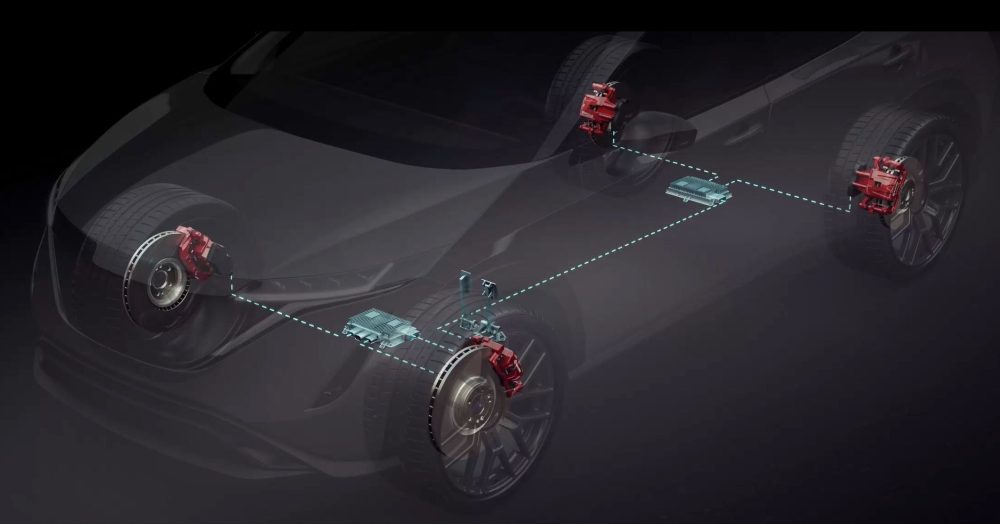
Brake-by-wire is the most quietly significant chassis change in a decade. In its most advanced form, it removes the master cylinder, the brake-fluid lines and the mechanical linkage between the pedal and the calipers, and replaces them with a sensor at the pedal, a controller, and electrical actuation at each corner of the car. Most production systems today still retain hydraulics at the wheel-end (an electro-hydraulic, or EHB, architecture); the fully electromechanical (EMB) architecture is the long-term destination. The hydraulic brake has been the dominant production architecture for passenger-car braking since the 1920s, when Duesenberg and later Chrysler brought four-wheel hydraulic systems into the mainstream. Engineers now have a credible electrical alternative in series production.
Brake-by-wire is any braking architecture in which the driver’s pedal demand reaches the wheels as an electrical signal rather than as hydraulic pressure transmitted through a sealed fluid circuit. The pedal becomes a sensor cluster. The controller becomes the arbiter of brake force at each corner. The actuator at the wheel, either a hydraulic plunger driven by an electric motor (EHB), or a fully electric caliper (EMB): does the work.
What Is Brake-By-Wire?
The change is partly hardware and partly software. A modern brake-by-wire system arbitrates between driver demand, ADAS demand (lane-keep braking, automatic emergency braking), regenerative-braking demand from the electric motor, and stability-control demand from the chassis ECU. The software has to blend those four sources in milliseconds, every braking event, for the life of the vehicle, without ever surfacing the transition to the driver. That blending is where the engineering value lives.
EHB and EMB Full Forms
The two abbreviations used throughout brake-by-wire engineering are straightforward. EHB is the full form of electro-hydraulic brake. EMB is the full form of electro-mechanical brake. A third abbreviation, BBW, is simply brake-by-wire, the umbrella term covering both architectures.
EHB vs EMB: The Two Architectures
Two architectures are live in 2026 and a third is being explored on test fleets.
Electro-hydraulic brake (EHB). The pedal-to-fluid link is broken, but hydraulic fluid still actuates the calipers. A motorised pump (often a brushless DC motor driving a ball-screw piston) generates the hydraulic pressure on demand. EHB is the dominant architecture today: Bosch iBooster, Continental MK C1, ZF IBC and Brembo’s earlier integrated systems are all EHB. EHB is well suited to ADAS because the controller can apply brake pressure without driver input.
Electro-mechanical brake (EMB). The hydraulic system is removed entirely. Each caliper has its own electric motor and the clamping force comes from a ball-screw or planetary-roller-screw mechanism. Brembo Sensify is the first EMB system in series production at scale, series production was confirmed in May 2026, and Continental, ZF and Bosch have all announced production plans for 2027-2028. EMB demands more from the in-car wiring, the power supply and the functional-safety architecture: there is no hydraulic fall-back if the electrical system fails.
Hybrid EHB/EMB. Some OEM development programmes are evaluating mixed-axle strategies, EHB on the front axle and EMB on the rear, to capture EMB packaging and regen-blending benefits at the rear while keeping a hydraulic fall-back at the front for the duration of certification. This is best understood as a transition architecture rather than a destination. Public evidence for production deployment is still limited; most disclosures sit at the engineering-prototype stage.
Functional Safety: ASIL D, Redundancy and the Single-Point-of-Failure Problem
Brake-by-wire systems carry the highest functional-safety target in passenger-car engineering: ASIL D under ISO 26262, the same level Mercedes-Benz’s Sensotronic Brake Control (SBC) had to clear in the early 2000s, an early production electro-hydraulic brake-by-wire system that pre-dated the current EHB and EMB push and serves as a useful precedent for the validation effort involved. The hydraulic brake circuit was, in effect, an analogue ASIL D system, pedal force compressed fluid that pushed pistons, and the only way to lose the brake was a fluid leak or a mechanical fracture. Brake-by-wire engineers have to rebuild that confidence in software and electrical hardware.
The standard pattern is dual everything: two controllers, two power supplies, two communication paths, two actuation paths per corner where possible. Nexteer’s recently launched steer-by-wire system, among the first ASIL D steer-by-wire architectures in series production, illustrates the pattern, and brake-by-wire systems are converging on the same redundancy strategy. OEMs are increasingly pushing single-point-of-failure analysis (SPFA) down to the harness and zonal-architecture level, though specific practices vary.
The Regulatory Dimension
UNECE R13H is the European braking regulation for passenger cars. It is technology-neutral on actuation, but it sets minimum stopping distances, dual-circuit independence requirements and parking-brake retention requirements that historically assumed a hydraulic system. R13H has been amended to allow EMB, but the certification effort for the first generation of EMB has been substantial: every approval is essentially a new technology approval, with witnessed testing and an extended type-approval package.
FMVSS 135 in the United States is similarly technology-neutral but creates additional design challenges for EMB because parking-brake retention is required with the electrical system off. EMB systems address this with spring-applied, motor-released clamp mechanisms that hold residual clamp force without electrical power. China’s GB regulations align closely with UNECE on braking but are evolving fastest for ADAS-blended braking.
Brembo, Bosch, BWI, Continental, ZF: Who’s Where in 2026
Brembo. Sensify entered series production in May 2026 at a global vehicle manufacturer, fitted as standard on 100% of the launch programme. Brembo describes Sensify as a fluid-free, distributed, by-wire platform and it appears to represent the first fluid-free EMB architecture entering large-scale production. Earlier Sensify demonstrations included hydraulic and mixed variants, so the exact architecture of the launch programme is worth confirming directly against Brembo’s technical disclosures before treating it as a clean reference point. Brembo has signed additional contracts and is scaling toward hundreds of thousands of units per year.
Bosch. Bosch iBooster (EHB) is in volume production across multiple OEMs. The successor system, branded around the Integrated Power Brake family and a Bosch EMB programme, is targeting series production in 2027 on premium European platforms.
BWI Group. BWI Group launched its integrated Dynamic Brake Control (iDBC) 1-Box system in Europe in July 2026, the company’s first European brake programme. The iDBC is an EHB architecture: a motorised pressure supply unit replaces the vacuum booster, with a direct hydraulic path from the pedal pushrod retained as the ASIL D mechanical backup. The company states that pressure build is around three times faster than a vacuum-boosted actuator, with ABS, stability control, regenerative blending and one-pedal drive handled by a software stack developed in-house.
Continental. MK C1 is the high-volume EHB. The Continental Future Brake System (FBS), incorporating EMB, has been demonstrated on Chinese OEM platforms and is targeted for series production in the 2027-2028 window.
ZF. ZF Integrated Brake Control (IBC) is the dominant EHB system on North American and European platforms. ZF has shown a dry-actuation EMB concept and is committed to production but has been slightly slower than Brembo to commit to a specific launch programme.
What Engineers Should Watch Next
Three signals matter most over the next 18 months. One: the Brembo Sensify in-service data. The first 12 months of warranty claims and dealer service events on the launch programme will set the tone for OEM appetite for EMB. Two: the Bosch and Continental EMB launches in 2027. Once a second OEM ships EMB at scale, supply-chain pricing drops and the cost-of-EMB-vs-EHB argument tips in favour of EMB on most new programmes. Three: the regulatory loop. The industry expects regulators to refine R13H and FMVSS pathways for EMB over the next several years; the exact form and timing of those updates is still open.
For OEM chassis engineers, the practical question is no longer whether to plan for brake-by-wire. It is how to sequence EHB-on-current-programme into EMB-on-next-programme without paying twice for development and validation.
Frequently Asked Questions
Brake-by-wire technology replaces the hydraulic link between the brake pedal and the wheel calipers with an electrical signal, a controller and electrically driven actuators. Two architectures are in production: electro-hydraulic brake (EHB) and electro-mechanical brake (EMB).
EHB keeps hydraulic actuation at the wheel calipers but generates the hydraulic pressure with a motor-driven pump on demand. EMB removes the hydraulic system entirely and uses an electric motor at each wheel to apply the clamping force directly.
Yes. EHB systems from Bosch, Continental and ZF have been in volume production for several years. Brembo Sensify, the first EMB system in volume series production, entered production in May 2026.
Brake-by-wire systems are classified ASIL D under ISO 26262, the highest automotive functional-safety integrity level. This drives dual controllers, dual power supplies, dual communication paths and redundant actuation strategies.
Brake-by-wire lets the ADAS or autonomous-driving controller apply braking force directly, without driver input, with millisecond latency, blended with regenerative braking and electronic stability control. That is harder to do cleanly with a conventional hydraulic system.
EHB is the full form of electro-hydraulic brake and EMB is the full form of electro-mechanical brake. Both are brake-by-wire (BBW) architectures: EHB retains hydraulic actuation at the caliper and generates pressure with a motor-driven pump, while EMB removes hydraulics entirely and clamps with an electric motor at each wheel.
Further Reading From the ATN Chassis Library
- Brembo Sensify Brake Technology Enters Series Production
- BWI Group Launches Integrated Dynamic Brake Control System
- Nexteer Steer By Wire: First ASIL D System In Series
- Marelli Debuts Active Suspension And Active Camber Technology
- EV vs Hybrid Powertrain: Which Fits Each OEM Strategy?
- UN Adopts Binding Global Rules For Automated Driving Systems
- DIL Simulator Explained: Driver-in-the-Loop Testing Guide
For more chassis news, click here.
