

 By ATN Editorial Team
Summary: Symbio will unveil its third-generation hydrogen fuel cell stack technology at IAA Transportation 2026. The Symbio fuel cell stack will be fitted as standard to the company’s forthcoming 150-kW StackPack system for heavy-duty applications, with a B-sample version due for customer testing in January 2027, and will also form the core of a 300-kW system currently on bench test.
Key engineering takeaway: Symbio says the new technology combines dependability, compactness, durability and cost competitiveness. A new bipolar plate design with doubled active surface, combined with a newly developed stack compression architecture, brings the Symbio fuel cell stack down to 80 litres and 90 kg, which Symbio says is twice as compact as its previous systems. The technology is covered by 18 patents and adds a fuel cell monitoring system, PCB Flex, supporting over-the-air software updates.
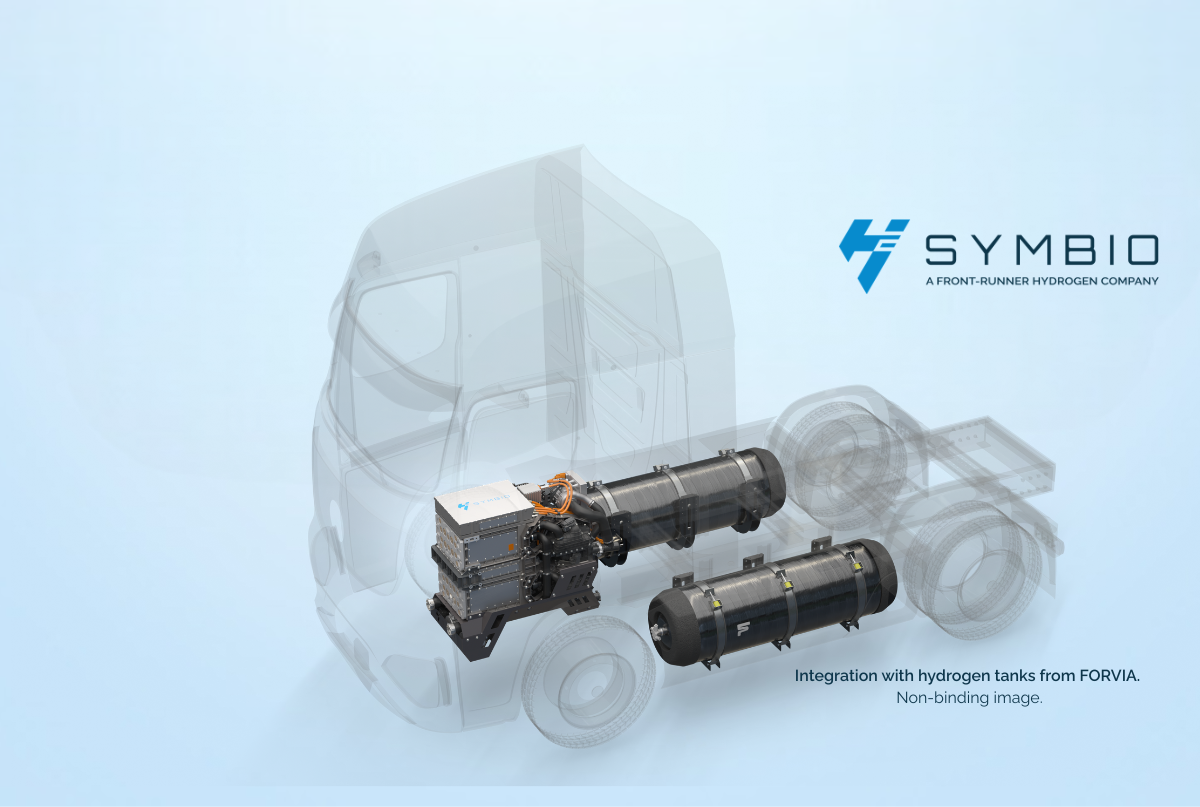
Why it matters: Symbio says the reduced volume of 80 litres and 90 kg makes the technology suited to integration into heavy-duty truck engine bays, including with front air suspensions. Symbio also says its Balance of Plant will enable multi-system combinations to reach the high-power requirements of generator sets in stationary applications.
Symbio will unveil its third-generation hydrogen fuel cell technology, specifically designed for the intensive use cases of heavy-duty mobility and stationary power generation at IAA Transportation 2026.
Combining dependability, compactness, durability, cost competitiveness and a tailor-made Membrane Electrode Assembly (MEA), this high-performance new technology will be featured as standard in Symbio’s upcoming 150-kW StackPack™ fuel cell system, tailored for heavy-duty applications, that will be available in its B-sample version for customer testing in January 2027. This technology will also be at the core of the 300-kW system, dedicated to extra heavy-duty applications which is currently under active bench testing for customer-based system design approach.
Inside The Third-Generation Symbio Fuel Cell Stack
Protected by 18 patents and featuring a tailor-made, fully integrated MEA, this new technology demonstrates proven efficiency, durability and cost competitiveness tailored for the hydrogen-electric transition of intensive use cases:
- Dependable: designed to simplify the maintenance and maximize uptime for intensive operations, it features advanced onboard diagnostics, predictive maintenance, and a breakthrough fuel cell monitoring system, PCB Flex, for over-the-air software updates.
- Compact: featuring a new bipolar plate (BPP) design with doubled active surface combined with a newly developed stack compression architecture, it is twice as compact than Symbio’s previous systems. Its reduced volume (80 liters, 90 kg) makes it ideal for integration into heavy-duty truck engine bays, including with front air suspensions. It is also ideal for stationary applications, thanks to its Balance of Plant that will enable multi-system combinations to reach the high-power requirements of generator sets.
- Cost efficient: developed for industrialization with a design-to-cost approach, its advanced functional integration and smaller number of components contribute to a competitive total cost of ownership (TCO).
- Sustainable: Symbio’s third-generation stack technology has been designed with lifecycle impact in mind. It complies with the EU Corporate Sustainability Due Diligence Directive (CSDDD), and is to be manufactured in Symbio’s SymphonHy gigafactory, certified as “Very Good” by the BREEAM® framework.
Scaling Production At The SymphonHy Gigafactory
This new technology is part of Symbio’s long term strategy, Symbio’s roadmap focuses on scaling production, strengthening expertise and expanding strategic partnerships.
- Industrial scale: SymphonHy, Europe’s largest integrated fuel cell gigafactory spanning 26,000 m², has been designed to streamline and optimize the entire manufacturing process, from catalyst ink formulation to the complete fuel cell system assembly. This end-to-end industrial approach has already demonstrated a production capacity of 100 systems per week with the previous product generation. As production ramps up, the facility is expected to reach an annual capacity of 10,000 systems, including the commercially available StackPack™ 75 fuel cell system serving stationary power, buses, coaches, logistics, and material-handling applications.
- End-to-end expertise: Symbio combines competencies across the full fuel cell value chain, from materials science and stack design to system integration, hybridization, customer support and training, for all intensive use cases.
- Co-development partnerships: Symbio is actively engaging OEMs and industrial partners to co-develop solutions tailored to the specific requirements of heavy-duty mobility and stationary power markets, including its 150-kW system that will be available for customer testing as soon as January 2027, and its 300-kW system that will be ready for customer testing in January 2028.
“The introduction of our new 150 kW fuel cell stack marks a decisive milestone in Symbio’s development strategy. By combining performance, durability, industrial scalability, and environmental responsibility, we are addressing the requirements of the most demanding hydrogen applications. This technology reflects our ambition to make hydrogen-electric solutions a competitive and sustainable choice for heavy-duty mobility and stationary power generation,” said Jean-Baptiste Lucas, CEO of Symbio.
Symbio booth: hall 11, A17, IAA Hannover Messe 2026. Press Day: September 14, 2026. Opening Days: September 15 to 20, 2026.
Frequently Asked Questions
What is the Symbio third-generation fuel cell stack?
The Symbio fuel cell stack is a hydrogen fuel cell stack technology built around a new bipolar plate design and a tailor-made membrane electrode assembly, covered by 18 patents. It will be fitted as standard to Symbio’s forthcoming 150-kW StackPack system for heavy-duty applications, and will also sit at the core of a 300-kW system for extra heavy-duty applications.
What is a bipolar plate, and how does doubling its active surface shrink a stack?
A bipolar plate sits between adjacent cells in a stack. It carries current from one cell to the next, distributes hydrogen and air across the electrode surface through machined or stamped flow channels, and carries coolant. Active surface is the area of that plate actually taking part in the reaction. Doubling it means each cell produces roughly twice the current, so fewer cells are needed for a given output. Since stack length is set by cell count, taking cells out is the most direct way to shorten the stack.
How compact is the Symbio fuel cell stack?
Symbio states a reduced volume of 80 litres and 90 kg, which it says makes the technology twice as compact as its previous systems. It credits a new bipolar plate design with doubled active surface combined with a newly developed stack compression architecture.
What is the difference between a fuel cell stack and a fuel cell system?
The stack is the electrochemical core, the compressed column of cells where hydrogen and oxygen react to produce electricity. A fuel cell system adds the balance of plant, typically an air compressor, humidifier, hydrogen recirculation, cooling circuit, power electronics and controls. Symbio’s fuel cell system is called StackPack. The balance of plant consumes some of the stack’s gross output, chiefly through the air compressor, which is why system output is always lower than stack output and why the distinction matters when comparing specifications.
When will Symbio’s 150 kW and 300 kW systems be available?
Symbio states that the 150-kW StackPack will reach B-sample status for customer testing in January 2027, and that the 300-kW system, currently on bench test, will be ready for customer testing in January 2028. A B-sample is a pre-production prototype intended for customer evaluation.
For more fuel cell news, click here.
