

 By ATN Editorial Team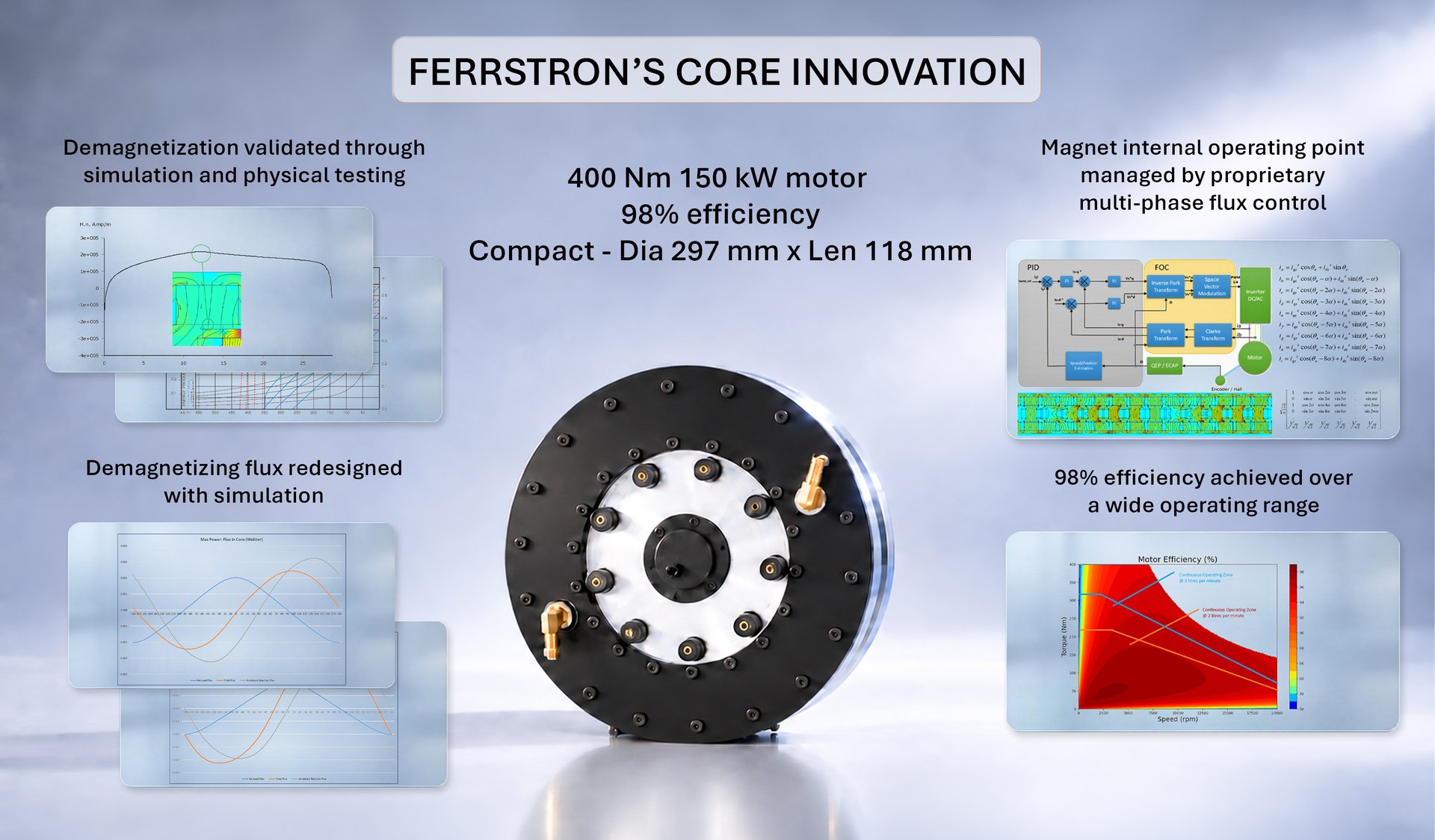
Summary: Pune-based Ferrstron Powertrains has tested a physical prototype of its 150 kW, 400 Nm powertrain in a 2.3-ton multi utility vehicle, an on-road test with full system integration that the company says takes its ferrite-magnet, rare-earth-free motor technology to Technology Readiness Level 6 (TRL6).
Key engineering takeaway: Ferrite magnets are significantly weaker than rare earth magnets, both in magnetic strength and in their ability to withstand demagnetisation. Ferrstron says its rare-earth-free motor compensates through high overall magnetic flux, higher armature reaction, a reduced demagnetisation effect from that armature reaction and multi-phase electromagnetic flux control that shifts the magnet’s internal operating point away from the demagnetisation limit, alongside a dual airgap motor design and winding with in-coil cooling. The company claims 98% efficiency with high power density.
Why it matters: Ferrstron frames heavy-duty electric propulsion as a field where high efficiency and an ultra-compact form factor have, until now, only been achieved with rare earth magnets. Its stackable cartridge roadmap scales the same rare-earth-free motor technology from a 400 Nm cartridge for passenger and light commercial vehicles to 1100 Nm cartridges stacked to between 1100 Nm and 5500 Nm for medium and heavy-duty trucks and buses.
Ferrstron is developing electric powertrain technology for electric propulsion in High-Speed Trains, Marine Vessels, Heavy-Duty Trucks and Buses, as well as Megawatt scale power generation in direct-drive Wind Turbines and Data Centre Gensets. Such heavy-duty applications demand high efficiency and ultra-compact form factor, only achieved through rare earth magnets till now.
Ferrstron Powertrains breaks that constraint. Ferrstron’s motors, emerging from strong electromagnetic physics simulation, achieve 98% efficiency with high power density while using ferrite magnets that are abundantly available at low cost.
Earlier this month, Ferrstron recorded a key milestone that substantiates its simulation capability through real-world validation. Ferrstron tested a physical prototype of its 150kW, 400Nm powertrain in a 2.3-ton Multi Utility Vehicle. Driving a vehicle of this category with ferrite magnets has been an elusive target for auto companies worldwide. The on-road testing of the vehicle validates the performance of the motor in full system integration in a real-world environment.
Electromagnetic Physics Simulation And Ferrite Flux Control
Under founder Vishal Sharma’s leadership, a veteran of advanced engineering simulation who spent his career at the heart of global engineering innovation — in product development at Dassault Systèmes and MSC Software, a NASA spin-off renowned for pioneering simulation technology — Ferrstron began with a proprietary electromagnetic physics simulation technology that powers every aspect of its innovation, from dual airgap motor design to the creation of a multi-phase flux control algorithm formulation.
Ferrite magnets are significantly weaker in comparison to rare earth magnets, both in terms of its magnetic strength as well as in its ability to withstand demagnetization. Ferrstron’s technology compensates the same through
- Creation of high overall magnetic flux
- Creation of higher armature reaction, thus requiring less flux from the magnet
- Reduction of demagnetization effect of armature reaction
- Multi-phase electromagnetic flux control to shift magnet internal operating point away from the demagnetization limit
“This unique electromagnetic balance has been achieved by a combination of innovations in multiple areas – architecture defining magnetic circuit, geometry and placement of key elements within the magnetic circuit, winding with in-coil cooling and finally a proprietary multi-phase flux control algorithm,” explained Vishal Sharma, Founder and CEO of Ferrstron. “Each of these innovations are an outcome of hundreds of simulations, followed by multiple physical prototypes and advanced tests over a period of last seven years.”
Rare-Earth-Free Motor Cartridge Roadmap And Production Plans
The entire range of applications that Ferrstron plans to target will be addressed through few core torque categories of stackable cartridges. The concept designs have already been validated with extensive simulation.
- 400 Nm Cartridge
Configurations – stacking single and double cartridges for powertrains of up-to 800 Nm
Applications – passenger vehicles and light commercial vehicles - 1100 Nm Cartridge
Configurations – stacking up-to 5 cartridges for powertrains from 1100 Nm to 5500 Nm
Applications – Medium & heavy-duty trucks and buses, Distributed Traction High Speed Trains - 8500 Nm Cartridge
Configurations – stacking up-to 10 cartridges for motors and generators from 1 MW to 10 MW
Applications – Electric & Hybrid Marine Propulsion, High Speed Onshore Wind Turbines, Data Centre Gensets - 1850 kNm Cartridge
Configurations – stacking up-to 11 cartridges for 10 MW to 21 MW direct drive wind generators
Applications – Offshore Wind Turbines
Having achieved a Technology Readiness Level 6 after the latest on-road testing with full system integration, Ferrstron is embarking on the next phase of its development program.
“Ongoing discussions with global Tier 1 and OEMs show the desire to eliminate the use of rare earth materials; we are spot on.” said Randolph Toom, Head of Global Strategic Partnerships at Ferrstron. “We are talking to investors to raise our next round of investment to achieve TRL 8 and start production.”
Rare-Earth-Free Motor: Frequently Asked Questions
What is a rare-earth-free motor?
A rare-earth-free motor is an electric motor that avoids rare earth magnet materials such as neodymium and dysprosium, either by using permanent magnets made from abundant materials such as ferrite or by using a design with no permanent magnets at all. Ferrstron’s motors use ferrite magnets, which the company describes as abundantly available at low cost.
How does Ferrstron make ferrite magnets work in a heavy-duty motor?
Ferrite magnets are weaker than rare earth magnets in magnetic strength and in resistance to demagnetisation. Ferrstron says it compensates by creating high overall magnetic flux, creating higher armature reaction so that less flux is needed from the magnet, reducing the demagnetisation effect of armature reaction, and using multi-phase electromagnetic flux control to keep the magnet’s internal operating point away from the demagnetisation limit. It credits the magnetic circuit architecture, the geometry and placement of key elements, winding with in-coil cooling and a proprietary flux control algorithm.
What did Ferrstron’s on-road test involve?
Ferrstron tested a physical prototype of its 150 kW, 400 Nm powertrain in a 2.3-ton multi utility vehicle. The company says the on-road testing validates the motor’s performance in full system integration in a real-world environment and brings its core technology to Technology Readiness Level 6.
What does TRL6 mean?
Technology Readiness Level 6 is the stage on the nine-level TRL scale at which a representative prototype has been demonstrated in a relevant environment, typically integrated into a wider system. TRL 8 generally means the complete system has been qualified for its final form. Ferrstron says it is raising investment to reach TRL 8 and start production.
Which vehicles is Ferrstron’s cartridge range aimed at?
Ferrstron plans a 400 Nm cartridge, stacked singly or doubly for powertrains up to 800 Nm, for passenger vehicles and light commercial vehicles, and an 1100 Nm cartridge, stacked up to five times for 1100 Nm to 5500 Nm, for medium and heavy-duty trucks and buses and distributed traction high-speed trains. Larger 8500 Nm and 1850 kNm cartridges target marine propulsion, wind turbines and data centre gensets.
Further Reading
- What Is A High Power Density Motor? An Engineer’s Guide
- MAHLE MCT Magnet-Free Electric Motor Debuts For Heavy Trucks
- Niron And ASPINA To Develop Rare-Earth-Free Motor Solutions
- FEV And RWTH Aachen University Develop Rare-Earth-Free Electric Drives With Modular Rotors
For more eMotor news, click here.
