

 By ATN Editorial Team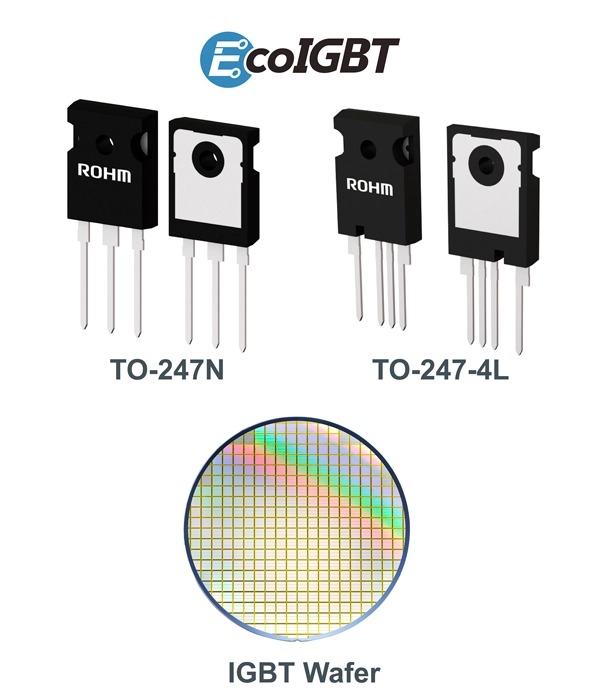
Summary: ROHM Semiconductor has developed a 4th generation automotive 650V IGBT family for electric compressors, high-voltage heaters and industrial equipment inverters. The lineup includes 12 TO-247N parts and 10 bare wafer products, with the TO-247N parts and selected bare wafer products available now and 12 TO-247-4L parts in development.
Key engineering takeaway: The automotive 650V IGBT reaches a collector-emitter saturation voltage of 1.55 V while holding a short-circuit withstand time of 7 µs at a junction temperature of 25 °C. ROHM attributes the pairing to a redesigned device structure covering the process and the edge termination, and says the parts increase current density while cutting both conduction and switching losses. All are qualified to AEC-Q101.
Why it matters: While SiC is increasingly adopted in high-power applications such as traction inverters, the automotive 650V IGBT is widely used as a switching device in lower-power auxiliary systems such as electric compressors and HV heaters, where inverter and heater circuits need short-circuit tolerance sufficient to endure the time needed to detect and interrupt overcurrent. ROHM describes the low conduction loss, with a VCE(sat) of 1.55 V, as class-leading among automotive-grade 650V-class products, based on a ROHM August 2026 study.
ROHM Semiconductor today announced it has developed 4th Generation 650V IGBTs ideal for automotive electric compressors and HV heaters, as well as inverters for industrial equipment. As automotive-grade 650V-class products, new IGBTs achieve class-leading* low conduction loss with VCE(sat)= 1.55V, while providing high short-circuit tolerance and complying with the AEC-Q101 automotive reliability standard.
As electric vehicles shift to higher voltages, SiC is increasingly adopted in high-power applications such as traction inverters. At the same time, 650V IGBTs are widely used as switching devices in auxiliary systems with lower power capacity, including automotive electric compressors and HV heaters. Silicon IGBTs are also widely used in industrial equipment, particularly motors and compressors, and demand is expected to continue expanding.
These applications require greater energy savings and smaller equipment designs, creating strong demand for power devices that offer higher reliability, smaller size, and higher efficiency. In particular, inverter and heater circuits require short-circuit tolerance sufficient to endure the time needed to detect and interrupt overcurrent during a short circuit.
How ROHM Redesigned Its Automotive 650V IGBT
In response to these market requirements, ROHM redesigned the device structure, including the process and edge termination structure, to develop 4th Generation IGBTs that combine low-loss characteristics with high short-circuit tolerance while addressing higher-voltage requirements. By revising the device structure, the products increase current density while reducing conduction and switching losses. In addition, despite the trade-off between lower loss and short-circuit tolerance, the products ensure a long short-circuit withstand time of 7 µs at Tj = 25°C. This contributes to higher efficiency and improved reliability in applications.
Lineup, Packages And Availability
The lineup includes 12 products in the TO-247N package, the RGAxxTS65HR / RGAxxTS65EHR series, and 10 bare wafer products, the SG83xxWN series. ROHM is also developing 12 products in the TO-247-4L package, the RGAxxTR65HR/RGAxxTR65EHR series. Design models and materials needed for circuit design are also available for download from ROHM’s official website.
The TO-247N package products and selected bare wafer products have been available. Online sales are available for TO-247N package products through online distributors such as DigiKey and Farnell.
Going forward, ROHM plans to further expand the lineup in the same packages and develop compact, surface-mount IGBT products that adopt the TO-263L package and top-side cooling (TSC) packages. ROHM will continue to expand its lineup of high-performance IGBT products, contributing to higher-efficiency drive and miniaturization in automotive and industrial equipment applications.
- Automotive electric compressors
- Automotive HV heaters (PTC heaters, coolant heaters)
- Industrial equipment inverters
ROHM’s official website provides SPICE models that faithfully reproduce the electrical characteristics of the products in simulations, PLECS models for electrical circuit simulation, and other materials needed for circuit design. For more details, please visit the Field Stop Trench IGBT product page.
EcoIGBT is ROHM’s brand of IGBTs consisting of both devices and modules designed to meet the needs of high-voltage applications in the power device field. ROHM independently develops technologies essential for the evolution of power devices, from wafer fabrication and production processes to packaging and quality control methods. At the same time, we have established an integrated production system throughout the manufacturing process, solidifying our position as a leading power device supplier.
EcoIGBT™ is a trademark or registered trademark of ROHM Co., Ltd.
*ROHM August 2026 study
Further Reading
- What Is A Traction Inverter? An EV Powertrain Engineer’s Guide
- Valeo And ROHM Semiconductor Co-Develop Power Electronics
- Wolfspeed 1200V SiC Six-Pack: EV Traction Inverter Modules
- Ricardo To Develop GaN Traction Inverters For New Nissan LEAF
For more power electronics news, click here.
Frequently Asked Questions
What is an automotive 650V IGBT?
An automotive 650V IGBT is a 650-volt-rated insulated-gate bipolar transistor for vehicle use. ROHM’s 4th generation parts comply with the AEC-Q101 automotive reliability standard and are intended as switching devices in lower-power auxiliary systems such as electric compressors and high-voltage heaters.
How does an IGBT differ from a SiC MOSFET in an electric vehicle?
An IGBT is a silicon device with a bipolar output stage, so its on-state voltage drop stays roughly constant with current, which suits moderate switching frequencies and high current. A silicon carbide MOSFET switches faster with lower switching loss. ROHM notes that SiC is increasingly adopted in high-power applications such as traction inverters, while 650V IGBTs are widely used as switching devices in lower-power auxiliary systems such as electric compressors and HV heaters.
What does a VCE(sat) of 1.55 V mean in practice?
VCE(sat) is the collector-to-emitter voltage across the device when it is fully on. Conduction loss is roughly that voltage multiplied by the current flowing, so a lower figure means less heat for the same current, a smaller heatsink and better system efficiency.
What is short-circuit withstand time and why does 7 µs matter?
Short-circuit withstand time is how long a device can survive a fault that puts full bus voltage across it while it conducts. It sets the budget for the protection circuit to detect the fault and turn the device off. A longer figure of 7 µs at a junction temperature of 25 °C gives the gate driver more margin, and it normally trades against low conduction loss.
What is AEC-Q101?
AEC-Q101 is the Automotive Electronics Council stress qualification standard for discrete semiconductors. It defines the temperature cycling, humidity, bias and mechanical tests a part must survive before it can be specified for use in a road vehicle.
